Saturday, August 28, 2021

The Lost Street Fighter characters

I noticed that on the PS4 store you can buy Fighting EX Layer, and that it is 80% off from now until the some time in early September; about a week or so away. From $40 to $8 was a deal too good to pass up (it cost almost that much to add Terry Bogard as a DLC character!) so I bought it this morning (and Terry, because... c'mon, c'mon. It's Terry.) I've played it just a bit, and have some very early commentary.

  • I played with Kairi, who's the kinda sorta Ryu clone. My first thought is that he doesn't actually have a lot of moves; two or three "unique" moves, three special moves, and three similar and kind of unimpressive supers. Maybe there's some combos or something that I don't know about that will make him more fun to play, but in general, I thought he was a bit simplistic to play and I got a little tired of him extremely quickly; he just didn't have a lot of tactical diversity to bring to bear. Against the CPU, at least.
  • The game seems specifically geared towards online competitive play. Two different versus modes, one for online and one for offline are listed before even arcade mode. I've heard that the netcode is particularly good, and will match you up with players of your same skill level much better than almost all of its competitors, so that you actually have a fun experience playing online games, instead of just getting blown out by freaks who practice all of the time. But I can't comment on this first hand, merely note that the single player experience seems to be a bit lacking.
  • Not only that, the arcade mode wasn't particularly interesting to play. Instead of best two out of three, it was best three out of five matches. The CPU blocks a lot, so you throw out a lot of attacks that don't do anything before you finish your matches. I had several matches end because time ran out. Not the funnest way to play either. 
  • The characters have potential but Arika do absolutely nothing with them. Very little personality exhibited, and no story to speak of. Just a brief paragraph as an ending, which told me very, very little about the character. This is another indication that the competitive play is the focus for the developer. In my opinion, any game, no matter how much the devs want to focus on a multiplayer experience, that doesn't have a good single player mode is going to be one that eventually people don't play much of. No matter the genre. Look at Star Wars the Old Republic, for instance, and how they added a massive single player experience that they didn't expect to (and that they claim at least 80% of their players are focusing on). Look at Overwatch, which nobody played for more than a few months because it was all running around with bratty little kids and there wasn't anything else to do. There's a handful of exceptions here and there, and a good cooperative or competitive scene is important for a lot of games, but people better be able to just sit down with the machine and play it without relying on someone else, or they'll likely be disappointed pretty quickly. I think the devs made a mistake with their focus here.
  • The game looks quite good. In fact, it just highlights how incredibly ugly Street Fighter V is in general, although that's a post for another time, because it's a big topic. The characters look fantastic, if occasionally a little plastic. I didn't see any clipping going on, and the character and stage design was just well done. The strange anime character portraits at the select screen (which also show in the win and lose images, as well as in small form at the top of the HUD) are sometimes hit or miss, but the actual 3D models are great. The stages are really good too. Some of them have a weird deja vu feel to them, like Terry's train ride through the desert southwest of "West Albuquerque", although there's probably a reason for that, because it's Terry. But why does Hokuto (and Shirase, formerly known as "Bloody Hokuto") have a giant snaky background that looks like Mukai's stage in King of Fighters 2003? Anyway, all very well designed from a visual perspective. Nothing at all to complain about here.
  • There are hints offline that there is some kind of potentially interesting story here, even if it is derivative, about sealed demons breaking loose, forgotten memories, the main character Kairi turning into an Akuma-like creature, but not realizing it because he's lost his memory, etc. Sure, sure... the story seems to be ripped off from other games that already did it better in the genre; a kind of Orochi Lite, or something... but there's something here that sadly they do nothing with. In fact, you kind of don't know anything at all about it unless you look up stuff on Arika website (or other wikis), because it's not really in the game at all.
  • A lot of people probably enjoy this about the game, but I found, quite honestly, the barrage of options that you have to pick before you even start playing to be kind of strange and overwhelming to someone new. What is Classic vs Progressive? No explanation given. What the devil are all these different "Gougi" modes and what to they mean? No explanation given. Again, I have an internet and a browser, so it's not like I can't get some answers out there somewhere, although the game is sufficiently low key that there's less information on it available than you'd probably like to think. 

Anyway, I certainly recommend getting it at that price while you can, if you haven't. At that price, heck, even if you only play it for a few hours total, it's probably still worth it. I doubt it's going to really creep up into superstar status, rivaling King of Fighters or Street Fighter, but it's not a bad game so far, and there are a lot of things that it does do really quite right. It's also the repository of a whole bunch of lost Street Fighter characters, the legacy of the EX spin-off series, and the fact that it has Terry Bogard as a DLC character opens up interesting crossover possibilities that I wish more of these jokers would get on board with. Let's face it, the fighting game genre isn't the top of the heap anymore like it was in the early to mid 90s, and all of the developers need to do more to keep their brands and their profile higher, I think. Or at least keep their existing fanbase excited to keep coming back for more. Big crossover games, and characters that are familiar but in a new setting, like Terry in this game, or Akuma in Tekken 7, or a female Skullomania in the SNK Heroines game is a fun concept, and fans eat that kind of stuff up. Keep doing more of it! In fact, that whole crossover potential is part of what prompted me to start this blog and the Google Sites for Karate Supers that I have. Sure, sure... I could just collect and play these games on my own. I could even record my playthroughs or something and put them on YouTube. But what I really want to do is imagine what it would be like to imagine this whole thing as the "karate supers cinematic universe" which, like the Marvel Cinematic Universe, would tell stories, somewhat "remixed" or redone with occasionally very different details to them, and mix up characters who otherwise might not be seen together in the same games already.

Terry Bogard appearing with the "lost" Street Fighter characters from the EX games in Fighting EX Layer is just a tiny taste of what I'd like to see more of.

Friday, August 27, 2021

Street Fighter vs King of Fighters

The year is 1998. Capcom has released, this year, its arguably most polished—and still considered one of its best entries in the entire Street Fighter series even now, years later—Street Fighter Alpha 3. It's in between the releases of Street Fighter III: Second Impact (1997) and Third Strike (1999). Its vs series has just barely graduated from Marvel Super Heroes vs Street Fighter (1997) to Marvel vs Capcom (1998) which expanded the roster from just Street Fighter characters to include characters from other Capcom franchises like Megaman, etc. That would be greatly expanded in the next game in the series, Marvel vs Capcom 2, but this was the first game that started the real trend of gonzo, spastic, novelty value of having such a tonal dissonance of characters all appearing in a crazy crossover game. Prior to that, the Marvel crossovers had been marginally more serious, and the Street Fighter games themselves obviously so, with a consistent tone and feel throughout. In many ways, 1998 was "peak Street Fighter" for a whole decade, while the franchise lingered under lazy, uninspired efforts, before being revived with Street Fighter IV in 2008.

Meanwhile, SNK also released King of Fighters '98 in 1998, obviously. Real Bout Fatal Fury 2 also came out that year, which although a tremendous game, had already had the spotlight taken from it to migrate to King of Fighters. While here in America, this was never really the case, in many markets in Asia and in South America in particular however, SNK was as popular as Capcom at the 2-D fighters, and the supposed rivalry between the two companies was catnip to games journalists, especially seeing as what even many years later many fans see as two of the best entries in both Street Fighter and King of Fighters came out in 1998. This fact was not lost on people at the time, of course, and both games were covered in the press, often in fact, in the exact same issue. At least one publication, Arcadia, plastered the title Street Fighter vs King of Fighters on its cover, and at least some fans, tantalized by that title, thought that that meant that some kind of actual crossover game was coming, as opposed to the magazine merely reviewing two of the best competing entries from each company in the same issue.

Whether this is literally true or not, this fan and journalist fervor is supposedly what prompted Capcom and SNK people to talk to each other and hammer out the license for what was to become the various Capcom vs SNK (and SNK vs Capcom) series of games. From the get-go, however, this concept was tainted by what was going on in the crazy, spastic Marvel vs Capcom stuff; the idea that we needed to add characters who had no tonal resonance with the others, just because the whole point was throwing everybody in a giant bag of a game and shaking it up until it broke. The Capcom vs SNK games were more serious in most respects than the Marvel vs Capcom game of the same era (2000-2002 or so) when they did finally come out in response to that stimulus in 1998, but for my money, they never quite lived up to the premise and promise of Street Fighter vs King of Fighters described in the headlines.

There are some other titles that qualify as similar in tone, of course, although most of them have already had some kind of crossover of sorts with the two flagship franchises. On Capcom's side, Rival Schools and Final Fight have always been associated with Street Fighter; Sakura appearing in Rival Schools and more recently, Akira appearing in Street Fighter V's final season. Final Fight characters were all over the place in the Alpha series already, and more of them have been more and more integrated into the Street Fighter franchise since. Although going back to 1989 already it was clear that they were going to be the same canon; the crush the car game from Street Fighter II was borrowed from Final Fight, and Final Fight's original title was going to be Street Fighter '89! Darkstalkers is a little more difficult; while the Darkstalkers titles have more or less the same vintage as the Marvel and Alpha games, and are obviously very similar to them in many, many regards, they do have an occasionally more gonzo tone than the Street Fighter games, at least. Although other Darkstalkers characters would fit in more closely with the Street Fighter cast. Curiously, as far as I'm aware, no Darkstalkers or Street Fighter character have actually ever appeared in the same game unless it was explicitly a crossover game (or puzzle fighter or something), however, and there hasn't ever been a Street Fighter vs Darkstalkers type property except for a comic book series published by UDON. I find this observation oddly compelling to noodle on. Some of the Street Fighter characters, especially Akuma, but also maybe Gill and Urien and Rose (and Menat) and more recently G (and Q) have the kind of vibe that would fit quite well in a Darkstalkers game. And with the successful relaunch of Street Fighter again, there's certainly been a call to do something with the Darkstalker characters besides an occasional cameo or cosplay alternate costume from many fans, which so far seem to have been unanswered and unaddressed. Curious and curiouser.

The King of Fighters games were always meant to be crossover games, of course, but they were primarily based around the concept of Fatal Fury and Art of Fighting and other similar characters; even characters like the US Sports team, the Psycho Soldiers team or the Ikari Warriors team were remade into a Street Fighter-like character representation. Fatal Fury and Art of Fighting characters, of course, were already in that mold. From time to time, characters who were a little more outrĂ© have popped up, like Nakoruru being a significant part of the plot of King of Fighters XIV, or some of the weird sub-bosses that showed up in King of Fighters XI, or especially all of the strikers that showed up in King of Fighters 2000. And curiously, a number of their actual bosses have always had a Darkstalkers like vibe too; I mean, what is Mukai and Magaki and Saiki and even Orochi for that matter, if not Darkstalkers in a Street Fighter-like game? The NESTS saga was less supernatural, but that only meant that it much more closely resembled the Street Fighter Alpha games, and later the G-project Street Fighter III stuff.

A few other games merit some mention. The Street Fighter EX games were, of course, Street Fighter games, but they were developed by Arika, and had a reasonably diverse cast of characters that have not appeared in mainline Street Fighter. The reason for this, it appears, is that the rights to those characters remained with Arika all this time, so that even if Capcom wanted to use them (which isn't at all clear that they ever did) they couldn't have without making some kind of new deal with Arika to do so. Arika have not that long ago finally released a new Street Fighter-like fighting game of their own, featuring these characters. Curiously, they made a deal of some kind with SNK so that Terry Bogard appeared in their game, and Skullomania appeared in a strange King of Fighters spin-off. This raises the tantalizing question of including these Arika Street Fighter EX characters in with the Street Fighter and/or SNK characters as certainly plausible. 

There are a few more even more obscure but also tantalizing connections. Data East released a Street Fighter II-like game called Fighters History and Fighters History Dynamite, its sequel or upgraded version. This was released on the Neo Geo and just based on the look and gameplay of it, it's mostly a late Street Fighter II vintage copycat. These characters would fit very well. In fact, Capcom thought that they would fit so well, that they sued Data East for copyright infringement. They lost because of the scenes a faire doctrine, which in fact suggests that Capcom was right in believing that the FHD characters are basically Street Fighter wannabes. Curiously, the rights to use these old Data East characters are currently with SNK, and although they've done precious little with them, they have on occasion had crossovers and cameo appearances, including a FHD character appearing in one of the Maximum Impact King of Fighters 3-D games, and a crossover cellphone game using Fatal Fury and Fighters History characters. I'm not quite sure why they haven't introduced a few of them into their mainline King of Fighters series since they have the rights; maybe it's because they don't know that they'll retain the rights forever and don't want to be stuck unable to sell a title that they've produced. But it'd be pretty fun to see a Fighters History team or two, even if they're DLC "non-canon" characters make an appearance in a King of Fighters game.

A final one I'll note is another Neo Geo game, but one developed by another studio, Visco. This is Breakers and its update Breakers Revenge. For my money, this one is even more overtly Street Fighter II-like (with a handful of Darkstalker nods; I actually think Alsion III is a better manifestation of the mummy concept than Anakaris, for instance) yet it was Data East that got sued.

Both Fighters History and Breakers have cult followings for various reasons; the super solid gameplay of Breakers Revenge, for example, and some of the odd character designs for Fighters History Dynamite. While they are largely forgotten (if they were ever known to begin with) by the mainstream as merely Street Fighter 2 copycats, the fact that they were such clear Street Fighter II copycats, not to mention the occasional cameo of some of the characters in other games of the same type, raises the question of whether or not there's any value in adding a Street Fighter vs Breakers Revenge or vs Fighters History Dynamite angle to this crossover. Probably not, because hardly anyone is asking for it, the characters don't have as much depth or interest for the most part, and frankly just with Street Fighter vs King of Fighters alone you've got too many characters to choose from anyway. But... it remains a tantalizing feature; how do (or at least how can, the Darkstalkers characters, EX characters, Fighters History Dynamite and Breakers Revenge characters somehow get worked in to this massive crossover game that yet somehow still manages to have a consistent feel with characters that all feel like they belong there for the most part, without having bizarre characters that don't belong, like Megaman or Amingo or Phoenix Wright, or other characters that actually have appeared in crossover games? Probably mostly just to provide novelty value for the silliness of the concept of adding them, honestly.

Whew. So, where am I going with this? I don't know yet. I'd like to think that eventually I'll write a big fan fic that crosses over the Street Fighter and King of Fighters characters, with some nods towards Darkstalkers and maybe some of the other titles, but honestly, I'm not really doing anything there and not likely to in the immediate future. I am, however, putting together a more complete list of character on my Google Drive. I already had a list of mainline Street Fighter characters. I needed to add the recently announced Luke to the list, and decided, why not create more tabs and go all out? I've now done the EX characters tab, using all of the EX games, including the various iterations of Street Fighter EX and the two games that Arika published that are not Street Fighter. Next will be Darkstalkers, and then I can turn to the SNK titles. I'm doing that one last because it's by far the biggest and most difficult of them all to do.

UPDATE: I really buckled down and finished the lists after a couple of free hours. The King of Fighters rosters were—as anticipated—the most difficult to do. It also reminded me, actually, that there are a lot of really dumb King of Fighters characters. The developers, going back to the very beginning, really, have a strange fondness for introducing characters with bizarre "Japanese street fashion" outfits, although that's admittedly gotten much worse since Falcoon started working for the company. They also have a really bizarre tendency to like to enter little kids in the game, and there are tons of high schoolers and even younger kids padding out the roster. 

Whatever I do with these characters (including simply playing the games) I will very studiously ignore the worst of these.

Tuesday, August 17, 2021

Capcom vs SNK Pro vs Capcom vs SNK 2

It seems like it should be obvious that CvS2 is better than CvS Pro. But, if you have the Japanese import Dreamcast version of the latter, which I now do, then that's not necessarily true. I've had the PS1 version for some time, and it's notably not very pretty or fluid, although it plays quite well and is a perfectly fine game. The improvements that the Dreamcast version adds make the comparison between the two games a bit more unclear, though—it really does make it a much more pleasant if not even occasionally breathtaking experience. Let's talk about various areas where they differ from each other, and I'll talk about which one offers a better experience overall.


Character Selection. It's clear that the second game has a better character selection than the earlier version. However, this doesn't matter as much as you'd think unless you're a fan of a more esoteric character. I've actually only quite rarely played any character in 2 that isn't in Pro. My go-to characters, down to the second and third string, a bit deeper on the bench, are almost all characters that are in Pro. However, again—there's no doubt that the second game has more characters, and it also has better bosses. Shin Akuma and Orochi Rugal are simply better than the version of Geese and Bison that Pro has. But on the flipside, Pro has a more even theme and tone. While neither game is anywhere near as gonzo and spastic as the Marvel vs Capcom series had become, especially by the time MvC2 came out, there are still some characters that really don't fit the concept of Capcom vs SNK. Which, lets all face it, was really always meant to be about their iconic fighting game franchises, and specifically kind of Street Fighter vs King of Fighters with maybe a Darkstalkers, Fatal Fury or Art of Fighting character that wasn't in KOF thrown in just for kicks. The inclusion of Samurai Shodown and Last Blade characters just don't feel like they belong in this game. And of course while Morrigan was a perfectly fine fit as an unusual offbeat character but not too much so, her sprite was absolutely terrible, and has been mentioned by every reviewer who's ever talked about either of these games. (I should mention that Nakoruru is in Pro, and she seems to show up as a com player way more often than she should.)

I've got to give a slight edge to 2 over Pro, but much more slight than you'd think; only a tiny sliver of advantage.

Gameplay System. I'm covering three different things here: 1) button layout and moveset, 2) the ratio system, and 3) the groove system. While most people would say that 2 beats Pro handily on all three dimensions, I'm going to make the case that it doesn't; it either is the same, or even arguably worse. For my taste, of course.

1) Pro made the decision to switch to a SNK-like layout, using four buttons instead of the default Street Fighter scenario of six. While this meant that some moves had to be abandoned here and there, curiously, nobody's ever complained about the King of Fighters characters feeling move impoverished because they used four instead of six buttons, and nobody has really complained since the first month or two of release about the four button approach of Marvel vs Capcom 2. In fact, in an era when home ports to consoles were becoming much more important than arcade renditions of the games, you could easily make a case that a four button layout is much less awkward than the six button Capcom default. Unless you went out of your way to buy a specialty control pad, after all, you always only had four buttons on the face of your controller. I'm going to go out on a limb and say that I think the four button layout is better than the six button layout, and I've always been slightly annoyed by trying to figure out the best way to map the six button layout to every four-button (plus triggers) control pad I've ever used to play a Capcom fighting game, from the SNES, the PS1, the PS2, the PS4, the Xbox, the Dreamcast and my USB PC controller. Every single one of them would have benefited from being designed to be a four-button game rather than a six button game. Of course, this isn't an issue for the SNK games, all of which are four button games to begin with... if they aren't even three button games for that matter, which a few of the Fatal Fury titles are.

2) I don't like the ratio system for either game. Luckily, there's actually no reason to play it for either game if you don't like it. Pro has the Pair Mode, where you ignore the ratios and pick two characters of your choice, who are merged into ratio 2, regardless of what they originally had been in the ratio mode. 2 has a slightly better selection; offering a 3x3 mode that is like the pair mode but obviously with three instead of two characters, as well as a regular Street Fighter-like 1x1. Normally, I'd suggest that the 1x1 is essential for the way I like to play, because I don't like having to mentally switch gears between characters. This is one of my bigger complaints with the regular gameplay associated with the King of Fighters games, although most of those titles also offer a well-done 1x1 mode as well. I find, however, that picking two characters instead of three doesn't trigger that reaction in me; I guess switching between two characters I can handle, whereas switching between three is too many to be fun for me and subconsciously stresses me out or something. I can't remember the last time that I played either game using the default ratio system, and I can't imagine why I ever would again. The ratio system simply was a bad idea, and even improving it between Pro and 2 didn't make it worth using, when there are better options right there in both games anyway.

3) I suppose some people like the number of grooves that 2 offers over Pro. I can certainly see that, especially if you're a fan of a particular groove that is unique to 2 rather than Pro. 2 has six grooves; C-A-P-S-N-K. C is almost exactly the same as A-ism from Street Fighter Alpha 3. A-groove is similar to the V-ism of Street Fighter Alpha 3. P-groove is most often compared to the Street Fighter III games, because of the presence of parry. Although parry was difficult to pull off in III, and it's even more difficult to master in this game. If you're really good at it, it's probably the best groove, but I'm not, so I don't care for it. S-groove has the manually charged super meter, and Desperation moves when you're health bar is red, similar to the earliest KOF games. N-groove is similar to the advanced mode that later KOF games started to develop, including 97 and 98 (and maybe 96? I'm drawing a blank now on that one.) K-groove is an interesting mashup of Samurai Shodown features and Mark of the Wolves features, making it a unique groove. This choice is great if you like one of the new grooves, or like playing around with optional things in the system and having lots of choices. There's even a groove edit mode where you can create your own grooves. However, after trying all of them out for a bit, I now only play C-groove on 2. I have no interest anymore in any other groove, although if for some reason I had to pick another one, I'd go for N. Pro only has two grooves, and although they don't have the same names, they are identical to C-groove for Capcom and S-groove for SNK. Since I can't imagine that I'd ever pick another groove again other than Capcom/C-groove, and it's present in both games and works exactly the same in both, the additional choices of 2 offer me nothing that I actually want.

I'd say that the button layout is a very slight advantage to Pro over 2 and a similarly slight advantage goes to 2 over Pro for offering the 1x1 and 3x3 over the 2x2 of Pro. Neither has an advantage in groove selection, because both offer me the only groove that I'm still interested in playing ever again. On this dimension the two games, therefore break even.

Presentation. In terms of the sprites, they are basically the same for both games, and there are, honestly, issues with them. The handful of redrawn Street Fighter sprites (just Ryu, Ken, Chun-Li and M. Bison, I believe) and the obviously newly drawn SNK sprites all look pretty good. Ironically, by the time even the first of these came out, many of the SNK characters had migrated to improved looks; Kyo's NESTS saga look was a big improvement over his Orochi saga look, for instance, but it's the latter that got drawn in the Capcom style. Regardless, that's all nearly top of the line for the era, and can't really be complained about. The rest of the Capcom sprites, however, don't look nearly as good. Everyone always points out how terrible Morrigan looks, and while it's true that she has the worst looking sprite in the game, many of the older Alpha vintage sprites really aren't that much better. Not only that, they really aren't drawn in the slightly more serious style that the SNK characters and redrawn Street Fighter characters are. A few new characters (and by new I mean drawn from much older games) from the Capcom side got ported to 2 that weren't in Pro, like Maki, Kyosuke or Eagle, and they also had to be redrawn in the newer style. The Alpha sprites look fine in their own game, but they are somewhat more cartoonish than the style that the SNK and redrawn Capcom sprites are in, which causes further graphical confusion; they just don't all look like they belong in the same game at all. (To be fair, this is also true even for some 3-D models that are in the same game. SFV has characters that look ridiculous next to characters that look really good. The newly released Akira in particular simply looks like she shouldn't be in the same game at all as the totally whiffed up Ken model.) However, while this is an issue, it's equally an issue for both games, so I can't give either game a leg up in this regard. Other parts of the presentation are different however.

While I don't think either game has really very memorable music, Pro's music is substantially better than the really generic Eurodancy soundtrack of 2. In general, I'd say Capcom was really whiffing on their music selection in this era too; this is the era of Marvel vs Capcom 2; the worst music ever featured in a major fighting game, and Street Fighter III. (To be fair, I'm really only familiar with the Third Strike music. But I didn't like most of that either.) Neither game is anywhere nearly as ridiculous as MvC2 (and yes, I realize that the music has grown on many fans. I'm not one of them. If anything, I find it even more obnoxious the more time passes. But I have other reasons for not really loving that game too.) I think 2's music is comparable in its weird badness to Third Strike, whereas Pro's music is comparable in its pretty generic run-togetherness to Alpha 3. Ironically, I once really liked the music to Alpha 3, but after hearing the really well-done remakes of the classic Street Fighter themes, plus the equally cool stage scenes that Overclocked Remix did (both for the HD Remix of SF2, and on their own before even) and the OST for Street Fighter IV, that Alpha 3 has not aged well in comparison. I still think that both Alpha 3 and Pro are fine for the era in which they came out, and they at least don't distract from the game, like MvC2 does, but they really aren't all that good either.

Otherwise, the look and feel of the stages is also very much better in Pro than in 2. Now, I didn't appreciate this as much for many years, because I only had the PS1 version of Pro, but with the Dreamcast version, it's obvious that many of the stages in this game are literally the absolute best 2-D stages ever produced, while the 3-D stages from 2 (and MvC2 for that matter) are probably the worst stages produced in general. Now, I don't necessarily hate 3-D stages in their own right. I think later 3-D stages, like those in KOF 2002 UM or KOF 1998 UM, for instance, look great, and there's some other really cool console port stages of what were originally 2-D stages in the arcade versions for some games that I also quite like. But I certainly don't think doing stages in 3-D just because you can is an improvement, and the stages in 2 are just awful, with only a couple of exceptions (the two boss stages, as it happens.) Really well-done 2-D stages have aged quite well, and have a kind of timeless beauty to them now that the early 00s 3-D video game design simply doesn't have. That era really kind of is a wasteland of very ugly, blocky polygon graphical design that looks terrible almost across the board, no matter the type of game. Curiously, though—it's less the technical limitations of the era that make the stages so unlovely as it is simply the design of them. I've got to give the edge, and it's a more substantial edge than we've seen before in these comparisons, to Pro over 2.

Total. Now, exactly which of those dimensions are most important to you may vary from what are most important to me. And some of my preferences there are obviously fairly subjective. Although I'll note that with the music in particular, I hear people make repeated mention of the "this is true love we're making" track of the London stage, and I've got to think that they've just developed a nostalgic fondness for an ugly track, the same way many have for "I'm gonna take you for a ride" from Marvel vs Capcom 2 rather than because it's an objectively good song or anything. But for my money, I'd have to say that it adds up to me being more likely now to play Pro than 2. Now don't get me wrong. I played a lot of 2 over the years, and I played probably a bit less of Pro when I had it only on the PS1. But now that I have the Dreamcast version, even with the Japanese, which I can't read a lick of, I just think that I prefer playing that one and probably will for the foreseeable future. All of the "improvements" made to 2 over Pro ended up being improvements that I don't really value that much, meaning that in most respects I can consider it an improvement from an academic perspective, but my own personal experience is actually a downgrade.

Monday, August 16, 2021

Story Summary: Art of Fighting series

The Art of Fighting game came out not too long after Fatal Fury. Like that one, it takes place in Southtown (albeit earlier than Fatal Fury) and features two playable characters, Ryo and Robert, who go through town fighting against gangsters and ruffians on the lookout for Ryo's kidnapped sister (Robert's girlfriend) Yuri. This makes it much more like Final Fight in terms of story, albeit more like Street Fighter or Fatal Fury in terms of gameplay. It turns out she's been kidnapped by Mr. Big, who looks kind of like a typical 70s pimp.

There's a secret boss after Mr. Big, though... Mr. Karate. He's a guy who wears a mask, and he's got Yuri kidnapped. And the then the game ends on a cliffhanger after you beat Mr. Karate, right after Yuri starts to tell you who this masked Mr. Karate really is.

And this is where the story really starts; in the first game, it's pretty straightforward and pretty much the same as Final Fight; just go through town beating up some bad guys and find the kidnapped girl, beat the final boss, and she's saved. Hurray. But what we find out when Art of Fighting 2 starts is that actually Geese Howard is the real culprit. He's killed Ryo's mother, and sent Takuma Sakazaki (Ryo and Yuri's father) into hiding. Mr. Karate is, himself, Takuma, playing some game where he's trying to protect his children by working with Mr. Big, yet also keeping Yuri in his pocket so Geese can't reach him. Anyway, whatever exactly the plot of gang activity was that was going on in the first game (it's never explained exactly what it is other than "gangsta stuff", basically) was foiled by Ryo and Robert, another tournament takes place in the second game. This time, you go fight "young Geese". When you beat him, he simply flees to Japan, plots the murder of Jeff Bogard, who's been poking around investigating him, and presumably he's been chased out of Southtown for the time being, only to reappear some ten years later during the Fatal Fury game.

Of course, when Ryo appears in Fatal Fury Special, he's not aged, and when both the Art of Fighting teams and Fatal Fury teams appear in King of Fighters, they're the same age that they are in their own respective titles. This is because the King of Fighters takes place in an alternate time line. While it makes off-hand references to the events of the series to which they come from, no timing of any kind of implied.

There's a final Art of Fighting game, and while it also features both Ryo and Robert, the protagonist of the story is now Robert rather than Ryo. He runs into a girl he knew as a child, who's father is missing, and he runs around in the Sonoran border region of Mexico looking for her, and fighting with bounty hunters, and others who are all in it for some alleged cash prize. Her father was kidnapped and killed by Wyler, who's a boss I'd like to see make a comeback sometime. Together they've developed some kind of flawed super soldier serum, who turns him into a Mr. Hyde monster. 

Although Wyler is a bad guy who killed this girls father, at the end, his mind is broken and childlike, and she decides that she needs to stay and take care of him (I don't get it.) Robert shrugs and leaves, heading for the airport. 

Curiously, alone in the world of fighting games, here we actually have the resolution of a romantic plotline. Yuri and Ryo come to see Robert off at the airport, and then after he exits stage right, Ryo pulls a ticket out of his pocket, gives it to Yuri, and tells her to go get him. Yuri then follows Robert into the sunset. Every other potential couple is locked in the indecisive phase.

I think this may be a feature of Japanese storytelling, though. Ranma ½, the only anime that I've ever liked, does this too. The entire 7 season run of the series is based on an "everyone knows that they're supposed to get together" (except for the rivals, of course) but they never really actually do. While it's not my favorite genre by a long shot, I have watched a number of rom-coms with my wife, and I actually do think Pride & Prejudice is a true classic of English literature that everyone of English heritage should read. It's hard to imagine any of them being satisfying if they spend all this time on set-up and then refuse to give you the payoff at the end. 

Anyway, I don't know that the Art of Fighting series is worth checking out if you haven't already. The gameplay is generally much more primitive than even the earliest King of Fighters games. I will give Art of Fighting 3 generally some credit for having absolutely beautiful backgrounds and stages (although the zoom feature often makes them appear unattractively pixelated) and for having an interesting tangent story that does something different than all of the other SNK stories, really. Other than that, the story is only marginally more interesting than Fatal Fury, if it is indeed more interesting, and is notable only for the introduction of characters who were later real standards in the King of Fighters games. However, it's Terry, not Ryo, who became the de facto mascot of SNK, and while the conceit of King of Fighters was bringing together the heroes from a number of games in the same title in a crossover jamboree (the Art of Fighting and Fatal Fury teams being the most notable here), they also had their own protagonist(s) and villain(s) that were unique to King of Fighters. The Art of Fighting team, like the Fatal Fury team, ultimately end up becoming sidelined, and even come and go to some degree. (Although Terry and Ryo always make an appearance, at least. The rest of the cast sometimes rotates a bit.) Yuri makes an interesting pivot from being merely damsel in distress to being an active participant before it's all done.

But mostly the story offers little that can be useful. I think Final Fight's "go beat up bad guys and rescue the damsel in distress from gangsters" storyline is better, even though that's a beat-em up, not a fighter. The cliffhanger reveal that Mr. Karate is actually Takuma Sakazaki, Yuri and Ryo's own father, is more of a headscratcher than an interesting and compelling plot twist. It never really makes any sense why kidnapping Yuri is supposed to help with anything at all. Mostly, I think it's important to establish the relationship between the Art of Fighting and Fatal Fury characters, although given the time depth that's supposed to separate them, that becomes an interesting aside rather than something important.

In the KOF Maximum Impact line, Ryo is older and is now Mr. Karate instead of Takuma. At least in his alternate costume, although he does have a "classic" look too. This lends a little bit more credence to the idea that the Maximum Impact games are actually supposed to be a continuation of the Art of Fighting => Fatal Fury series, although since they go a completely different direction than the Mark of the Wolves game, I have no idea how that's supposed to work. Mark of the Wolves also features a character who's part of Ryo's karate tradition, and supposedly Ryo's protege, with the 70s blaxploitation look and bizarre name of Khushnood Butt (sometimes Marco Rodriquez), furthering the ties between the two series. 

It'd really have been nice to see a bit more of the two series tied together in Mark of the Wolves 2, but after SNK went bankrupt and the new SNK Playmore had to reacquire their own I/P from Eolith, or whomever ended up with it, and the hardware underwent major revision, that game was shelved. It was (supposedly) about 70% done, but since it was going to go on the old MVS hardware, one can pretty confidently assume that it'll never be revisited again at this stage, unless someone else does it.

The artists who did the Streets of Rage 4 reboot asked fans what they'd like to see them do some fan art mockups for, and Mark of the Wolves 2 was what was picked, though, suggesting that there's still some demand out there for this stuff. They turned out a pretty nifty mock up (see below) which seems to open the possibility, no matter how remote, that maybe some continuation of the Art of Fighting and Fatal Fury stories will yet happen, through a revised Mark of the Wolves 2, or some such title.


Thursday, August 12, 2021

Character Focus: Terry Bogard

Since I just did a summary of the Fatal Fury series, it seems appropriate to focus briefly on Terry Bogard, the star and protagonist of that series, and my favorite of the SNK lineup of characters to play. In a KOF playthrough, I almost always turn to Terry first and most, and he's the character I'm most comfortable and familiar with of the SNK lineup.

That said, he's had a lot of changes over time. Not just to his look, but moves come and go in bizarre fashion. Some of his appearances have a move list twice as long as some of his other appearances. For his pretty radical redesigned look, which appeared in Fatal Fury: Mark of the Wolves and was used as well in King of Fighters 2003 and XI, he didn't have one of his signature moves: Rising Tackle. He's still a great character to play without it, but missing it was very strange.

Speaking of which, Rising Tackle is usually a flash-kick motion to execute, but for some of the later Orochi saga games, and King of Fighters 98 in particular, it was a dragon punch motion. Then it went back to being a flash kick again in 99 and beyond. So weird.

While Terry's initial backstory is that he was driven by the need for revenge against Geese for the murder of his father, Jeff Bogard, he kind of evolved into the voice of cool, chill, laid-back wisdom from the cast; the one everyone saw as a legend, who gave encouragement, etc. Although this may be a weird Japanese-ism, he doesn't appear to have been too smooth with the ladies. Blue Mary obviously had a thing for him, but it doesn't appear that they actually ended up together for long after all, according to Mark of the Wolves anyway, where no mention of her is to be found. Although to be fair, in SNK fighting games, everybody already has a coupled up relationship with someone else, or they never actually seem to close the deal (Art of Fighting 3 Yuri and Robert being the only exception I can think of.)

Terry also is obviously connected to his brother Andy Bogard and his friend Joe Higashi. The three of them are the OG Fatal Fury team from the King of Fighters, also known sometimes as the Italy team, because I guess that's where Andy prefers to live, or something. He's had some other team-ups too, though: in 99 when teams were four people, Mai was on the team, for instance. In 2000 and 2001, it was Blue Mary, but alternate strikers were all over the map: Geese Howard being particularly associated with Terry, for instance (Duck King, Billy Kane and Ryuji Yamazaki being other alternates associated with the team.) In the Ash Crimson saga, the teams got significantly mixed up; Terry's Fatal Fury team in 2003 had Terry, Joe and Tizoc. In XI it was Terry, Kim and Duck King. XIII and XIV were back to the classic line-up.

Because he's been turned into this friendly, laid-back kind of personality, he seems to be friendly enough with everyone on the Fatal Fury roster, and most of the King of Fighters roster, except for overt villains or their henchmen. Billy Kane has evolved over time into being more of a rival than an enemy.

And of course, his closest associated character in recent years is Rock Howard, since after Geese's death, Terry took him in and raised him.

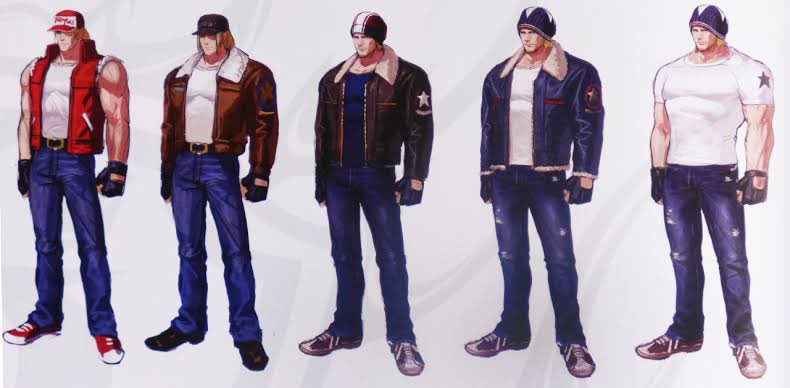
Anyway, I've got some concept art of Terry. His classic look actually has more variations than some realize; in the earliest Fatal Fury game, his jacket was a jacket with rolled up sleeves to below his elbow, not a vest with ripped off sleeves. Later, some of his Fatal Fury appearances had a regular t-shirt under his vest with an actual sleeves, although his classic look is sleeveless. His leather bomber jacket and no hat or ponytail Mark of the Wolves look (sometimes called Wild Wolf) is his most notable alternate, and lots of Terry fans somewhat reluctantly (because it's not classic) admit that they like it better. I'm not reluctant at all about it; the only complaint I have about the bomber jacket look is that he never seems to have his Rising Tackle move. People don't seem to love his KOF XIV look, but it seems like a slightly redesigned variation on his very original look to me.

Anyway, here's some alternate concepts that SNK have developed. Some of them are pretty cool. Some of them are stupid beyond belief.


The classic look to the far left. Next to it is the Mark of the Wolves look, with the addition of a ball cap. All of the rest I've never seen before, but I think that they're actually really good. I'd happily use all of them as alternates.


Some variations on the original Fatal Fury 1 design. they ended up turning into the KoF XIV design below.


The classic look and some really bizarre alternates, below. I actually don't mind that green jacket thing. A kind of male cosplay of Blue Mary, I guess. Blue Terry? I think that it might have been an alternate costume in Maximum Impact 2, but I never played that game. The big belt pouch on the classic is a new addition that isn't a terrible idea. The far right two concepts have ridiculously big belts. But then, so did Blue Mary. The American flag look is ridiculous, of course. The black, gray and red one is... I dunno. I need to think about it to see if it grows on me or not. Probably not, though.
The Mark of the Wolves costume (albeit in a pretty stylized style) along with some of the worst alternatives I've ever seen. What is he, a Vegas performer in the 70s here? A stripper who can't make up his mind if he's going for a cowboy or a fireman persona?


I like the concept of a good alternate, and as the Mark of the Wolves design shows, even a really bold new direction isn't necessarily a bad new direction. However, most of these designs are... not all that great. The top bunch are all designs I could get behind, however. Some of these designs look like what ended up coming out as weird alternates in KOF 2006, which was called Maximum Impact 2 in Japan. In fact, that game is famous for—mostly—the bizarre alternate costumes. Other than that, it was a kind of predictable and boring Tekken clone with some SNK characters.

Wednesday, August 11, 2021

Story Summary: Fatal Fury series

I hadn't intended to start with Fatal Fury, or even do it at all, but given that Fatal Fury and Art of Fighting were the genesis in a way of the King of Fighters series, and also that their plots are pretty simple and straightforward, I thought it worth doing. The Fatal Fury series in particular is notable for having a number of "dream matches" that are just recreations of prior games, but have no canonical story implications; it's just "lets get all of the characters back together for a big fight, exactly like we already did, but let's tweak the gameplay and character selection."

The original plot is as simple as this: Terry and Andy are brothers, and their father (adoptive, I believe) was killed by a rival, Geese Howard, who's now a mafia-type crime boss in the American city of South Town (or Southtown sometimes). Howard stages a street-fighting martial arts tournament. Terry and Andy join, because at the end they'll be able to fight Geese and get their revenge. Their friend, Joe Higashi, who's a Muay Thai fighter (even though he's Japanese. Because SNK is a Japanese company and they always focused mostly on the Japanese market) joins too, although his story seems to be little more than he's the Bogard boys' friend, and he wants to be famous. 

Later more story developed to flesh out this plot, like Tung Fu Rue was Geese and Jeff (Daddy) Bogard's master, but he chose Jeff to teach his best techniques to, because Geese was a bad guy. This prompted Geese to kill Jeff. Tung Fu Rue was also Terry and Andy's master at some point. Of course, he's also one of the opponents you must face in the game's progression. A few more minor characters get a little bit of flavor backstory, but not much.

Anyway, supposedly Terry wins. Hilariously, in the cutscene animation, he seems to have forgotten all about getting revenge for his dad's murder, and just enjoys being the champion and partying with some women. And then, of course, Geese's thugs bring him to Geese's penthouse office suite, which is decorated in a bizarrely Japanese fashion, and they fight. Terry ends up knocking Geese over the edge, where he falls to his death Hans Gruber style... except that he doesn't die for several more games, and he keeps coming back even though he's supposedly dead even so.

For Fatal Fury 2, a German nobleman is curious as to the guys who were able to defeat Geese, so he hosts another tournament with the hopes of meeting them. This is Wolfgang Krauser (often pronounced and occasionally spelled Klauser, heh). We never really find out much about what Krauser's deal is, although we do find out that he's Geese's half brother, and some kind of really tough and brutal fighter. Other than that, we never actually find out about him actually doing anything villainous, in fact, the background material makes a bigger deal of his honor and sense of fair play, while also calling him "the Emperor of Darkness" and saying he's a villain. Show, don't tell! Anyway, we're told he's bad, so I suppose he must be, but I have no idea what he does that's so bad other than host a tournament so he can be the boss, and being related to Geese.

He does also have a progression of sub-bosses, almost exactly like M. Bison does. In fact, the similarities don't end there; we have a Spaniard matador (Vega clone) a new boxer (Balrog clone), and then Billy Kane. He's not exactly a Sagat clone by any means, but he's at least got connections to the first game as a sub boss there. Other than that, only one of the NPCs from the last game returns, albeit with a totally different name, and everyone else is new. But they have as much story and personality at this point, at most, as the characters from the very first Street Fighter 2 game, i.e., essentially none.

Anyway, Terry wins again, because he's the protagonist of the series and he always wins Fatal Fury games. Fatal Fury Special is the follow-up to this game. Although it's a bit difficult to tell, I don't believe it has a unique story; it's just a fleshed out and improved version of Fatal Fury 2. Kind of like how Super Street Fighter II was to Street Fighter II. Geese returns in this game although the mystery of his survival is never explained. It's also hinted here that Krauser had taken over Geese's empire during his absence, but given that Geese is a South Town local and Krauser is in a castle in Germany, that seems a bit unlikely.

Fatal Fury 3 is the next game, and curiously Geese, while in the game, is not the boss. Instead we have some really dumb blue- and red-haired kids (SNK have a bizarre fascination with little kid fighter characters, especially little girls. Really odd.) There are some ancient scrolls that have some kind of secret on them, and for some reason they're lost in South Town, even though they were made in China. Everybody wants them. Yamazaki makes his debut in this game, and he's the criminal everyone wants to stop, but Jin Chonshu and Chonrei, the dumb kids, are actually the bosses. Nobody's ever clear on exactly what the scrolls do, but the Jins seem to think that they confer immortality, and some characters, like Sokaku, seem to think that the Jins were delusional and corrupt. The scrolls remain a bit of a cypher and a MacGuffin, on which anything needed can be put as a plot device, I presume. According to some sources, but not in game ones, the Jins are posssessed by the spirits of their evil ancestors who want to resurrect themselves and conquer the world using the scrolls, although the idea that this would actually work is supposed to be the delusion. These ancestor spirits depart after the boys lose in Fatal Fury 3. It's implied in some dream match endings that they end up with Kim Kaphwan, training and being raised in his dojo along with his own kids, although for the most part, the twins are forgotten except as cameo characters after this.

Apparently, as we find out from material related to the next game, Real Bout Fatal Fury (Real Bout was an alternate title that was tossed around in development, but ultimately abandoned before the first game was released. Someone obviously liked it well enough to revive it as a subseries subtitle), Geese won the scrolls, or at least ended up with them somehow. But he didn't want to use them, either because he feared them, or just because he only wanted them to prove something in the first place. And he goes about reestablishing himself after his "resurrection" as the crime lord of South Town again. It's not clear if we're to interpret resurrection as in he literally died and somehow came back to life, or resurrection in that he was presumed dead but wasn't actually. Anyway, he holds another tournament in South Town, pretty much the same as the first game, except that some of the participants have changed. Terry wins again, and faces Geese on his tower... again. Somehow Geese's penthouse office catches fire during the fight, and Geese is knocked off of the tower... again. Terry tries to catch him, but Geese doesn't let him, falling to his death once again. At some point here, Terry ends up with Rock Howard, Geese's son, who's a little boy at this point. I doubt Geese left Rock's custody up to Terry in his will, but hey—laws and whatnot don't seem to matter much in these games.

There are two more games that follow which are both dream matches; Real Bout Fatal Fury Special and Real Bout Fatal Fury 2. But because they are "dream matches" they have no story implication; it's just an excuse to put all of the fighters back together again, in a much prettier setting this time. I actually really quite like these two games, and consider them among the best of the Fatal Fury games, even though there aren't any real stories to speak of.

The final game in the series is Fatal Fury: Mark of the Wolves (admittedly, only the Dreamcast release calls it Fatal Fury, but it's clear that it's a continuation of the same series. I think this was just a botched localization effort; it was always meant to be called Fatal Fury outside of Japan.) This is an interesting addition to the canon, as it takes place ten years later than the other games. Rock is now grown up, as are some other little kid cameo characters, like Kim Kaphwan's two boys. Terry is the only returning character, and he's been redesigned (for the better.) They start a whole new storyline, which takes place in South Town's neighboring city, Second South, just to the east. Someone named Kain R. Heinlein is hosting the tournament, and he supposedly is, again, a crime lord, although from the look of him, he's a weird costume party tuxedo caricature-wearing aesthete. Japan. Weirdos. 

Anyway, it turns out that Kain is Rock's uncle; the brother of Rock's mother, Marie Heinlein Howard, whom Geese kept hidden so that she wouldn't be targeted by his rivals, or some such. Marie and Kain were raised on the streets under the eye of Abel Cameron. When Marie went off to marry Geese, Abel eventually became Grant, Kain's right hand enforcer man, who learned some kind of "dark karate" in the basement, where he still is when you face him. Kain has some kind of bizarro social Darwinism philosophy to make people happier by killing them if they can't fight, or some baloney like that, although this isn't explored too closely. Marie supposedly died of sadness because Geese was bad and didn't love her, or something like that.

In fact, a lot of stuff isn't explored very closely, because following SNK's bankruptcy, the in-development sequel never was released, leaving a number of cliff-hangers in the story. Rock seems to have gone off with Kain, but did he become a villain himself? There's hints that his mother actually didn't die after all, but went even deeper into hiding or seclusion, although that's unknown and why she would do that is completely unexplained. In any case, Rock is the protagonist, not Terry, this time around, and he is the one who won the tournament in a canonical sense, I think it's clear. Rock has made a few appearances here and there, but usually as either cameos or dream match type scenarios. There's a lot of demand to have him added permanently to the roster of King of Fighters, but reportedly the staff at SNK are resistant to this idea, because they want to save him for a potential Fatal Fury relaunch. That seems like a pipe dream to me; after over twenty years the series is going to get another entry? This leaves Rock and his story; the first really interesting one for the Fatal Fury games, in a kind of limbo. 

The exception here is the King of Fighters Tekken-clone PS2 era Maximum Impact spin-off. It's not clear if SNK takes these seriously in any way, although clearly the storylines and characters that they contain are not part of the mainline KOF story. In fact, there are hints that it was a what if contination of sorts of the Fatal Fury and Art of Fighting storylines, although if so, it starts all over with some kind of weird alien villains that we haven't seen before or since in any SNK game. Maybe I'll cover these in a later post... maybe. I think that they're best seen as their own odd little mini-continuity, although they do seem to have more in common in most respects with the Fatal Fury stories than the King of Fighters stories, and they do contain more Rock Howard appearances, and take place in and around Southtown specifically. It does also contain not only Terry Bogard, but also "Wild Wolf", the Mark of the Wolves era Terry, with a slightly different moveset, and the Mark of the Wolves look (at least as his default.)

While the Fatal Fury storylines don't offer a whole lot, they did bring us many memorable characters, particularly the main hero and villains themselves; Terry and Geese. Rock's story was a potentially interesting one too; events in his life curiously mirroring that of Geese himself when he was younger. However, because he had a Terry-figure in his life, he has a chance to reject the dark side of the force and not become Darth Vader... er, I mean another Geese, but rather a slightly darker version of Terry himself; a hero with an edge, if you will. Whether that storyline will ever materialize isn't likely, in my opinion, but we'll see. And, of course, the setting of South Town is integral to all kinds of SNK goings-on following this game.

The Jin scrolls as a potential plot device are kind of nifty too. Although the Jin twins as interesting characters are not.

But this is OK. While I do that games such as the King of Fighters series and the Street Fighter Alpha series had complicated plots that are difficult to unravel, or that Street Fighter V had a whole General Story mode that told an anime-like story in most respects, sometimes a simple yet compelling plot without lots of complications, and a simple yet compelling antagonist are all that's needed to be memorable. The more complicated plots often trip over themselves as often as they do something interesting, or get really silly and dumb (I'll conquer the world by using your fighting power as a battery seems to get used more than once, for instance) Geese is a pretty compelling antagonist. Maybe not quite M. Bison or even Rugal Bernstein level compelling, but much moreso than Chris as Orochi, or Gill, etc.

Tuesday, August 10, 2021

Gripe

Just a quick gripe. Don't know why I'm posting this except I feel like complaining, and nobody at the house understands.

My original Xbox system stopped working years ago. I have a number of games that are only for that system, because they never got any other North American release that belong to the Karate Supers genre. Sometimes I really want to revisit those games. Not a lot; to be honest with you, none of the games that I have for that system are ones that I really love. The closest of them that I'd really want to play frequently is King of Fighters 2002, but I have King of Fighters 2002 Unlimited Match from Steam, so I don't need to anymore.

But every once in a while, I really think I'd want to play a bit of Neowave, or 2003, or SVC Chaos, and then I can't because my Xbox doesn't work.

Sadly, replacement hardware is shockingly expensive. I'd have to pay more now for a refurbished Xbox than I paid ten years ago. Sure, there's probably a shortage of supply given the system's age, but still—c'mon, nearly $200 for a system that's been obsolete for more sixteen years already?!

I could replace at least one of my Xbox titles with a PS2 title. I do have a PS2 that works fine, and I've replaced some of my Xbox titles over time, such as King of Fighters 00/01 and Capcom vs SNK 2. However, also shockingly, the 02/03 game is one that I can't find for less than $50! That's not terrible money, but it's quite a lot for a game that I already know that I won't play much. I don't need the 02 game at all, and I don't love 03 enough to play it more than a little bit here and there. I'd pay $20 to buy it for the PS2, and feel like that was a worthy deal. $50 is more than its worth. And of course, the other two games that I'd potentially replace, I can't because they never got North American PS2 releases. 

Anyway... I guess that that simply means I won't be playing 2003 anytime soon. Which is kind of unfortunate, because sometimes I just get jonesing to pull it up and play it again. I disliked some elements of the gameplay of that particular entry, but I did really enjoy the atmosphere and character selection a lot. I mean, check out that boss stage!