Showing posts with label Fatal Fury. Show all posts

Thursday, August 12, 2021

Character Focus: Terry Bogard

Since I just did a summary of the Fatal Fury series, it seems appropriate to focus briefly on Terry Bogard, the star and protagonist of that series, and my favorite of the SNK lineup of characters to play. In a KOF playthrough, I almost always turn to Terry first and most, and he's the character I'm most comfortable and familiar with of the SNK lineup.

That said, he's had a lot of changes over time. Not just to his look, but moves come and go in bizarre fashion. Some of his appearances have a move list twice as long as some of his other appearances. For his pretty radical redesigned look, which appeared in Fatal Fury: Mark of the Wolves and was used as well in King of Fighters 2003 and XI, he didn't have one of his signature moves: Rising Tackle. He's still a great character to play without it, but missing it was very strange.

Speaking of which, Rising Tackle is usually a flash-kick motion to execute, but for some of the later Orochi saga games, and King of Fighters 98 in particular, it was a dragon punch motion. Then it went back to being a flash kick again in 99 and beyond. So weird.

While Terry's initial backstory is that he was driven by the need for revenge against Geese for the murder of his father, Jeff Bogard, he kind of evolved into the voice of cool, chill, laid-back wisdom from the cast; the one everyone saw as a legend, who gave encouragement, etc. Although this may be a weird Japanese-ism, he doesn't appear to have been too smooth with the ladies. Blue Mary obviously had a thing for him, but it doesn't appear that they actually ended up together for long after all, according to Mark of the Wolves anyway, where no mention of her is to be found. Although to be fair, in SNK fighting games, everybody already has a coupled up relationship with someone else, or they never actually seem to close the deal (Art of Fighting 3 Yuri and Robert being the only exception I can think of.)

Terry also is obviously connected to his brother Andy Bogard and his friend Joe Higashi. The three of them are the OG Fatal Fury team from the King of Fighters, also known sometimes as the Italy team, because I guess that's where Andy prefers to live, or something. He's had some other team-ups too, though: in 99 when teams were four people, Mai was on the team, for instance. In 2000 and 2001, it was Blue Mary, but alternate strikers were all over the map: Geese Howard being particularly associated with Terry, for instance (Duck King, Billy Kane and Ryuji Yamazaki being other alternates associated with the team.) In the Ash Crimson saga, the teams got significantly mixed up; Terry's Fatal Fury team in 2003 had Terry, Joe and Tizoc. In XI it was Terry, Kim and Duck King. XIII and XIV were back to the classic line-up.

Because he's been turned into this friendly, laid-back kind of personality, he seems to be friendly enough with everyone on the Fatal Fury roster, and most of the King of Fighters roster, except for overt villains or their henchmen. Billy Kane has evolved over time into being more of a rival than an enemy.

And of course, his closest associated character in recent years is Rock Howard, since after Geese's death, Terry took him in and raised him.

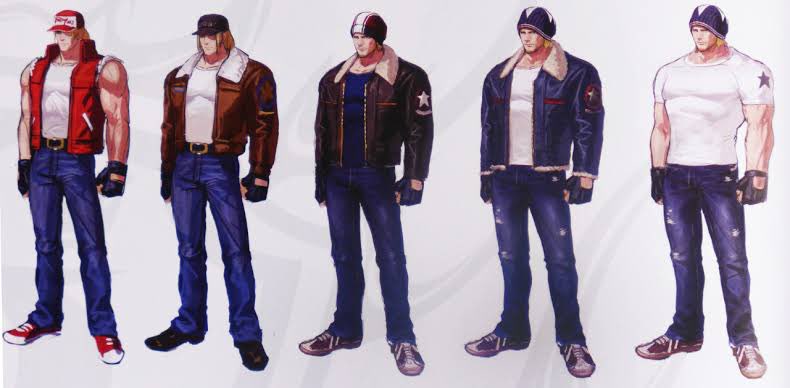
Anyway, I've got some concept art of Terry. His classic look actually has more variations than some realize; in the earliest Fatal Fury game, his jacket was a jacket with rolled up sleeves to below his elbow, not a vest with ripped off sleeves. Later, some of his Fatal Fury appearances had a regular t-shirt under his vest with an actual sleeves, although his classic look is sleeveless. His leather bomber jacket and no hat or ponytail Mark of the Wolves look (sometimes called Wild Wolf) is his most notable alternate, and lots of Terry fans somewhat reluctantly (because it's not classic) admit that they like it better. I'm not reluctant at all about it; the only complaint I have about the bomber jacket look is that he never seems to have his Rising Tackle move. People don't seem to love his KOF XIV look, but it seems like a slightly redesigned variation on his very original look to me.

Anyway, here's some alternate concepts that SNK have developed. Some of them are pretty cool. Some of them are stupid beyond belief.


The classic look to the far left. Next to it is the Mark of the Wolves look, with the addition of a ball cap. All of the rest I've never seen before, but I think that they're actually really good. I'd happily use all of them as alternates.


Some variations on the original Fatal Fury 1 design. they ended up turning into the KoF XIV design below.


The classic look and some really bizarre alternates, below. I actually don't mind that green jacket thing. A kind of male cosplay of Blue Mary, I guess. Blue Terry? I think that it might have been an alternate costume in Maximum Impact 2, but I never played that game. The big belt pouch on the classic is a new addition that isn't a terrible idea. The far right two concepts have ridiculously big belts. But then, so did Blue Mary. The American flag look is ridiculous, of course. The black, gray and red one is... I dunno. I need to think about it to see if it grows on me or not. Probably not, though.
The Mark of the Wolves costume (albeit in a pretty stylized style) along with some of the worst alternatives I've ever seen. What is he, a Vegas performer in the 70s here? A stripper who can't make up his mind if he's going for a cowboy or a fireman persona?


I like the concept of a good alternate, and as the Mark of the Wolves design shows, even a really bold new direction isn't necessarily a bad new direction. However, most of these designs are... not all that great. The top bunch are all designs I could get behind, however. Some of these designs look like what ended up coming out as weird alternates in KOF 2006, which was called Maximum Impact 2 in Japan. In fact, that game is famous for—mostly—the bizarre alternate costumes. Other than that, it was a kind of predictable and boring Tekken clone with some SNK characters.

Wednesday, August 11, 2021

Story Summary: Fatal Fury series

I hadn't intended to start with Fatal Fury, or even do it at all, but given that Fatal Fury and Art of Fighting were the genesis in a way of the King of Fighters series, and also that their plots are pretty simple and straightforward, I thought it worth doing. The Fatal Fury series in particular is notable for having a number of "dream matches" that are just recreations of prior games, but have no canonical story implications; it's just "lets get all of the characters back together for a big fight, exactly like we already did, but let's tweak the gameplay and character selection."

The original plot is as simple as this: Terry and Andy are brothers, and their father (adoptive, I believe) was killed by a rival, Geese Howard, who's now a mafia-type crime boss in the American city of South Town (or Southtown sometimes). Howard stages a street-fighting martial arts tournament. Terry and Andy join, because at the end they'll be able to fight Geese and get their revenge. Their friend, Joe Higashi, who's a Muay Thai fighter (even though he's Japanese. Because SNK is a Japanese company and they always focused mostly on the Japanese market) joins too, although his story seems to be little more than he's the Bogard boys' friend, and he wants to be famous. 

Later more story developed to flesh out this plot, like Tung Fu Rue was Geese and Jeff (Daddy) Bogard's master, but he chose Jeff to teach his best techniques to, because Geese was a bad guy. This prompted Geese to kill Jeff. Tung Fu Rue was also Terry and Andy's master at some point. Of course, he's also one of the opponents you must face in the game's progression. A few more minor characters get a little bit of flavor backstory, but not much.

Anyway, supposedly Terry wins. Hilariously, in the cutscene animation, he seems to have forgotten all about getting revenge for his dad's murder, and just enjoys being the champion and partying with some women. And then, of course, Geese's thugs bring him to Geese's penthouse office suite, which is decorated in a bizarrely Japanese fashion, and they fight. Terry ends up knocking Geese over the edge, where he falls to his death Hans Gruber style... except that he doesn't die for several more games, and he keeps coming back even though he's supposedly dead even so.

For Fatal Fury 2, a German nobleman is curious as to the guys who were able to defeat Geese, so he hosts another tournament with the hopes of meeting them. This is Wolfgang Krauser (often pronounced and occasionally spelled Klauser, heh). We never really find out much about what Krauser's deal is, although we do find out that he's Geese's half brother, and some kind of really tough and brutal fighter. Other than that, we never actually find out about him actually doing anything villainous, in fact, the background material makes a bigger deal of his honor and sense of fair play, while also calling him "the Emperor of Darkness" and saying he's a villain. Show, don't tell! Anyway, we're told he's bad, so I suppose he must be, but I have no idea what he does that's so bad other than host a tournament so he can be the boss, and being related to Geese.

He does also have a progression of sub-bosses, almost exactly like M. Bison does. In fact, the similarities don't end there; we have a Spaniard matador (Vega clone) a new boxer (Balrog clone), and then Billy Kane. He's not exactly a Sagat clone by any means, but he's at least got connections to the first game as a sub boss there. Other than that, only one of the NPCs from the last game returns, albeit with a totally different name, and everyone else is new. But they have as much story and personality at this point, at most, as the characters from the very first Street Fighter 2 game, i.e., essentially none.

Anyway, Terry wins again, because he's the protagonist of the series and he always wins Fatal Fury games. Fatal Fury Special is the follow-up to this game. Although it's a bit difficult to tell, I don't believe it has a unique story; it's just a fleshed out and improved version of Fatal Fury 2. Kind of like how Super Street Fighter II was to Street Fighter II. Geese returns in this game although the mystery of his survival is never explained. It's also hinted here that Krauser had taken over Geese's empire during his absence, but given that Geese is a South Town local and Krauser is in a castle in Germany, that seems a bit unlikely.

Fatal Fury 3 is the next game, and curiously Geese, while in the game, is not the boss. Instead we have some really dumb blue- and red-haired kids (SNK have a bizarre fascination with little kid fighter characters, especially little girls. Really odd.) There are some ancient scrolls that have some kind of secret on them, and for some reason they're lost in South Town, even though they were made in China. Everybody wants them. Yamazaki makes his debut in this game, and he's the criminal everyone wants to stop, but Jin Chonshu and Chonrei, the dumb kids, are actually the bosses. Nobody's ever clear on exactly what the scrolls do, but the Jins seem to think that they confer immortality, and some characters, like Sokaku, seem to think that the Jins were delusional and corrupt. The scrolls remain a bit of a cypher and a MacGuffin, on which anything needed can be put as a plot device, I presume. According to some sources, but not in game ones, the Jins are posssessed by the spirits of their evil ancestors who want to resurrect themselves and conquer the world using the scrolls, although the idea that this would actually work is supposed to be the delusion. These ancestor spirits depart after the boys lose in Fatal Fury 3. It's implied in some dream match endings that they end up with Kim Kaphwan, training and being raised in his dojo along with his own kids, although for the most part, the twins are forgotten except as cameo characters after this.

Apparently, as we find out from material related to the next game, Real Bout Fatal Fury (Real Bout was an alternate title that was tossed around in development, but ultimately abandoned before the first game was released. Someone obviously liked it well enough to revive it as a subseries subtitle), Geese won the scrolls, or at least ended up with them somehow. But he didn't want to use them, either because he feared them, or just because he only wanted them to prove something in the first place. And he goes about reestablishing himself after his "resurrection" as the crime lord of South Town again. It's not clear if we're to interpret resurrection as in he literally died and somehow came back to life, or resurrection in that he was presumed dead but wasn't actually. Anyway, he holds another tournament in South Town, pretty much the same as the first game, except that some of the participants have changed. Terry wins again, and faces Geese on his tower... again. Somehow Geese's penthouse office catches fire during the fight, and Geese is knocked off of the tower... again. Terry tries to catch him, but Geese doesn't let him, falling to his death once again. At some point here, Terry ends up with Rock Howard, Geese's son, who's a little boy at this point. I doubt Geese left Rock's custody up to Terry in his will, but hey—laws and whatnot don't seem to matter much in these games.

There are two more games that follow which are both dream matches; Real Bout Fatal Fury Special and Real Bout Fatal Fury 2. But because they are "dream matches" they have no story implication; it's just an excuse to put all of the fighters back together again, in a much prettier setting this time. I actually really quite like these two games, and consider them among the best of the Fatal Fury games, even though there aren't any real stories to speak of.

The final game in the series is Fatal Fury: Mark of the Wolves (admittedly, only the Dreamcast release calls it Fatal Fury, but it's clear that it's a continuation of the same series. I think this was just a botched localization effort; it was always meant to be called Fatal Fury outside of Japan.) This is an interesting addition to the canon, as it takes place ten years later than the other games. Rock is now grown up, as are some other little kid cameo characters, like Kim Kaphwan's two boys. Terry is the only returning character, and he's been redesigned (for the better.) They start a whole new storyline, which takes place in South Town's neighboring city, Second South, just to the east. Someone named Kain R. Heinlein is hosting the tournament, and he supposedly is, again, a crime lord, although from the look of him, he's a weird costume party tuxedo caricature-wearing aesthete. Japan. Weirdos. 

Anyway, it turns out that Kain is Rock's uncle; the brother of Rock's mother, Marie Heinlein Howard, whom Geese kept hidden so that she wouldn't be targeted by his rivals, or some such. Marie and Kain were raised on the streets under the eye of Abel Cameron. When Marie went off to marry Geese, Abel eventually became Grant, Kain's right hand enforcer man, who learned some kind of "dark karate" in the basement, where he still is when you face him. Kain has some kind of bizarro social Darwinism philosophy to make people happier by killing them if they can't fight, or some baloney like that, although this isn't explored too closely. Marie supposedly died of sadness because Geese was bad and didn't love her, or something like that.

In fact, a lot of stuff isn't explored very closely, because following SNK's bankruptcy, the in-development sequel never was released, leaving a number of cliff-hangers in the story. Rock seems to have gone off with Kain, but did he become a villain himself? There's hints that his mother actually didn't die after all, but went even deeper into hiding or seclusion, although that's unknown and why she would do that is completely unexplained. In any case, Rock is the protagonist, not Terry, this time around, and he is the one who won the tournament in a canonical sense, I think it's clear. Rock has made a few appearances here and there, but usually as either cameos or dream match type scenarios. There's a lot of demand to have him added permanently to the roster of King of Fighters, but reportedly the staff at SNK are resistant to this idea, because they want to save him for a potential Fatal Fury relaunch. That seems like a pipe dream to me; after over twenty years the series is going to get another entry? This leaves Rock and his story; the first really interesting one for the Fatal Fury games, in a kind of limbo. 

The exception here is the King of Fighters Tekken-clone PS2 era Maximum Impact spin-off. It's not clear if SNK takes these seriously in any way, although clearly the storylines and characters that they contain are not part of the mainline KOF story. In fact, there are hints that it was a what if contination of sorts of the Fatal Fury and Art of Fighting storylines, although if so, it starts all over with some kind of weird alien villains that we haven't seen before or since in any SNK game. Maybe I'll cover these in a later post... maybe. I think that they're best seen as their own odd little mini-continuity, although they do seem to have more in common in most respects with the Fatal Fury stories than the King of Fighters stories, and they do contain more Rock Howard appearances, and take place in and around Southtown specifically. It does also contain not only Terry Bogard, but also "Wild Wolf", the Mark of the Wolves era Terry, with a slightly different moveset, and the Mark of the Wolves look (at least as his default.)

While the Fatal Fury storylines don't offer a whole lot, they did bring us many memorable characters, particularly the main hero and villains themselves; Terry and Geese. Rock's story was a potentially interesting one too; events in his life curiously mirroring that of Geese himself when he was younger. However, because he had a Terry-figure in his life, he has a chance to reject the dark side of the force and not become Darth Vader... er, I mean another Geese, but rather a slightly darker version of Terry himself; a hero with an edge, if you will. Whether that storyline will ever materialize isn't likely, in my opinion, but we'll see. And, of course, the setting of South Town is integral to all kinds of SNK goings-on following this game.

The Jin scrolls as a potential plot device are kind of nifty too. Although the Jin twins as interesting characters are not.

But this is OK. While I do that games such as the King of Fighters series and the Street Fighter Alpha series had complicated plots that are difficult to unravel, or that Street Fighter V had a whole General Story mode that told an anime-like story in most respects, sometimes a simple yet compelling plot without lots of complications, and a simple yet compelling antagonist are all that's needed to be memorable. The more complicated plots often trip over themselves as often as they do something interesting, or get really silly and dumb (I'll conquer the world by using your fighting power as a battery seems to get used more than once, for instance) Geese is a pretty compelling antagonist. Maybe not quite M. Bison or even Rugal Bernstein level compelling, but much moreso than Chris as Orochi, or Gill, etc.

Monday, December 5, 2016

Today

It's been a long time since I've posted a new post on this blog.  I haven't picked up Street Fighter V, and I'm not likely to until it's been more thoroughly updated.  I did rent it and play it a bit, but it didn't grab me the way SFIV did when it was new.  Part of that was certainly the fact that there isn't tons of content on it yet, but the format and modes actually seemed to make it even harder to access the content that was there.  Once updated versions of SFV are out, I may wade in then.

In the meantime, although I've been pretty happy with the Ultra Street Fighter IV version on Steam, I'm seriously considering buying the PS4 downloadable port, just because I'd rather play it on the big TV on the Playstation, honestly.  I have never really taken to King of Fighters XIII although I have that on Steam too.  I'd like to rent XIV in the relatively short term, though, even though it's got some very, very odd entries in it (that guy in a dinosaur costume.  And what's with SNK always trying to stick Nakoruru in every title?  Augh! Blech!)  And Alice is now a playable character!  I guess I was ahead of the curve there, although she's been slightly redesigned (is now wearing a big over-sized t-shirt over her—admittedly rather immodest—traditional outfit.  They may have changed her last name on me too, and decided to make her "half Japanese."  Considering that she's still blond and blue-eyed, that's pretty absurd, but not unexpected, I suppose.

I haven't actually been playing all that much lately, although I've gotten back into SFIV just a bit as I've freed up enough time to be able to play just a bit here and there.  I've also broken out my PS2 on occasion and played some Real Bout Fatal Fury 2 and a few other titles here and there.  I don't know that any of this means that I'm resuscitating this particular hobby or just dabbling with some nostalgia.

Am I ever going to write the fan fiction that I started?  I dunno.  Probably not.  I'm not very motivated, and I don't actually know where I'm going with it; I just got caught up in excitement about the characters, as I have done before.  But you never know.

Wednesday, June 25, 2014

Southtown: A Brief Geography, part III

Part I
Part II

The river running southward from the hinterlands marks the far eastern boundary of "original" Southtown locations, but it marks the western boundary of the locations that turn up in Mark of the Wolves' Second South. The map here, taken from the game itself, and labeled (not by me; I found this online) has all the locations that turn up in that game. Notably, you can see the river that runs near the edge of mainland Southtown, as well as East Island and Geese Island. While the Port town island and the bay area aren't shown in the map, because we know them well from other maps, that's not a big deal. The majority of the locations are on yet another island, about twice the size of East Island, and farther to the east (ironically) connected to the mainland by several bridges, at least one of which is a train bridge--if you fight Terry on his moving flatcar, you can see the train run along the beach at sunrise, stop in the station, and then cross the bridge from the mainland to the island (or vice versa--can't tell from the stage art.)

While Second South's relationship to Southtown is difficult to ascertain from the games, certainly they are close neighbors and probably work together in many ways. Like Southtown itself, Second South seems to be a large city with high rise districts, ethnic neighborhoods (Korean, in particular), and apparently gambling has been legalized. That's actually not that amazing of a claim to make now, but in 1999 when this game came out, it's important to remember that gambling was rare in the US other than in Vegas or Indian-owned casinos. Second South is also a crime-riddled city. Kain Heinlein grew up in the worst neighborhood in Second South, and rose to become a criminal kingpin. Oddly, Second South seems to be a bit more anarchic than any real US city could possibly be--it talks of seceding from the US, for instance, and Heinlein's goals of fomenting chaos so that the residents have to fight for their lives in some kind of Darwinian survival of the fittest test couldn't possibly ever fly. Of course, I've said before that that's obviously one of the main conceits of this genre overall, though--a very hands-off, laissaz-faire government that allows folks, including foreigners and minors, to travel around getting into super-powered fist-fights in all kinds of public places. Freedom!

Here's the known locations from Second South.
  • Live House "Old Line" - Rock Howard's stage, and apparently his favorite hang-out. Although it supposedly welcomes hard rock musicians, based on the look, the stage BGM, the small size, and the older classic cars and hot-rods, I'd expect it to be the kind of place where middle-aged fans of Jimmy Buffet go to get drinks after work.
  • Philanthropy Belfry - Far enough away from the Pioneer Plaza cathedral that it attracts a completely different clientele, the Philanthropy Belfry is named for the fact that the it was built on funds raised from charity. You can just see the front of it in the second phase of Terry's train stage, so it's near a passenger train station on the mainland. Although it looks nice, and has a peaceful relaxing feel (and BGM) I can't believe it's very fun to be up there in the Belfry when those giant bells are ringing. Hey, I still have a copy of The Amazing Spiderman #300 where Spiderman and Venom face off in the Belfry. Nice issue. The first real appearance of Venom was in that story arc, actually.
  • Sarah Forest - The Sarah Forest is geographically quite close to the National Park swamps seen in Joe's Fatal Fury 3 stage, but it looks very different. This is probably attributable to its higher elevation--its a bit drier and cooler, and therefore looks like a typical temperate forest. Curiously, I think the karate bears are not meant to be taken too seriously, but the presence of a bald eagle sitting on a fallen tree is very atypical for the southern Florida climate.
  • 5th Avenue and 2nd Street - A rather typical junction in the busy downtown area of the island portion of Second South. Also, a dramatic demonstration of why karate supers fighters should be careful about where they throw down--innocent people could be hurt in these car accidents!
  • Oriental Casino "Woo" - Very close to the Korean Quarter, Oriental Casino Woo is a typical example of that particular attraction--a bit tawdry and full of flashing, blinking lights, and cheap superficially beautiful women. As casinos often are, this one is under the thumb of gangsters. Geese's criminal empire doesn't really go too far into Second South, but up and coming relative of his by marriage, Kain R. Heinlein, has been putting the squeeze on Mr. Woo for some time.
  • S. S. P. Maneuver Field - Short for Second South Police Maneuver Field, but no municipal police force has the wherewithal to have a training facility like this, and those choppers are not police type choppers, those are military. Actually, the SSPD only lease a small portion of what is otherwise a fairly secretive government base run by the military. The headquarters of the multi-disciplinary task force to contain and control criminal superhuman fighters is also located here. Members of that organization include SSPD, like SWAT team member Kevin Rian, as well as federal agents (Mary Ryan, Vanessa, Seth), international agents (Hon Fu, Cammy White, Chun-Li), the US military (Guile, Charlie), and even mercenaries (Heidern, Leona, Ralf, Clark, Whip, etc.) In fact, former military now mercenary colonel Heidern is the head of the multidisciplinary task force, so his office is located here. Not that he's always in it, by any means.  In addition, the vast base has a number of other buildings, basement levels, and other hidden and top secret experimental facilities. While there's no warehouse housing the Ark of the Covenant in a crate, the Jin Scrolls have been relegated to just such an ignominous fate--lost in a bureaucratic paperwork shuffle and buried under hundreds of other, identical crates. Experiments and research into the illegal cloning and AI technology that the supervillain organization NESTS is so fond of takes place here as well, and when Cammy, K' and Maxima all defected from NESTS, they were debriefed here first.
  • Slam "Free Field" - An extremely dangerous and run-down downtown district, full of criminal predators and the desperate. Second South also has an L-train or people mover of some sort, as demonstrated by the depiction of this neighborhood in Mark of the Wolves.
  • Universal Arena - Second South has a large athletic complex that is used most often as a pro-wrestling venue. However, like all such arenas, it's frequently re-purposed for other events, and when Athena came through town on tour last, she played here as well (stages from console version of King of Fighters XI.)
  • Blue Wave Harbor - This stage is under attack by a pirate band in a submarine when illustrated, but normally, it's a quiet marina and harbor, for commerce as well as personal pleasure craft. In this, it's a rival to the harbors and marinas of Sound Beach and Port town, but it staunchly faces away from them on the far side of Second South Island, as if unwilling to even look at its colleagues. This harbor is poorly patrolled, and because it's the closest to the open ocean to the east, drug smugglers on smaller yachts and other pleasure craft tend to favor Blue Wave Harbor over those in Southtown.
  • Barbaroi Falls - While the Barbaroi River seems to be the final, most eastward boundary of the original run of Fatal Fury, Art of Fighting and King of Fighters locations in Southtown, it's the westernmost boundary for Second South. As the waters rush down from the cooler mountains of the Sarah Forest to the swampy delta of National Park and the river's mouth on the coast, it changes elevation rapidly, and Barbaroi Falls is the most scenic and dramatic of several falls.
  • Yok Chong Market - In the Korean Quarter, this is an open air bazaar and market. Livestock and ethnic food can be purchased here, and most of the signs and conversation is in Korean. In addition, there are Taekwando dojos located here, and rivals from the various schools, easily set apart by their different-colored uniforms, often meet in this open air plaza for demonstration matches when the weather is good.
  • Freight Express - Part of the same railway system that runs through Southtown, the Freight Express, it's motto "Running Wild" is a local branch of the nationwide railway, Orion Pacific. Seen in Terry's stage, this is really three different locations completely--the first phase is a sunrise ride along the mainland coast, showing the rural suburbs and environs around Southtown and Second South to the east and north. Stopping briefly on the mainland, near Philanthropy Belfry is a passenger train station, where commuters board to head to Second South Island. And the part mapped here (and shown in the third phase of Terry's stage in MOW) is on the long bridge that crosses the channel leading to the island. The Freight Express continues westward to Southtown as well. Besides passengers, one of its most common loads is lumber, from the forested foothills and mountains around Southtown and Second South to Port town, where it will be shipped around the nation and the world.

Southtown: A Brief Geography, part II

Part I
Part III

Let's go through town, now, and take a look at known locations in and around Southtown. Let's start with the map below, which is a slightly modified and labelled take on the Fatal Fury 3 map, incorporating all of the known Art of Fighting and Fatal Fury locations. Second South will be the subject of a separate annotated map further down the page.

  1. National Park - The National Park is the location of Ryo's horse barn stage from Art of Fighting 2, as well as Joe's swamp stage with the prominent alligator from Fatal Fury 3. Although the coloration of the Art of Fighting 2 map seems to suggest some terrain relief, Joe's stage in particular seems to show that there are large areas of low, flat wetlands. This national park probably also extends to the other side of the river, at least as an undeveloped area if not actually administered by the park service. As it gets into the foothills further east, we come to Barbaroi Falls and the Sarah Forest from Mark of the Wolves.
  2. Pioneer Plaza - It seems unusual that such a large cathedral would be located on the outskirts of town, far from where the majority of the people can easily use it. Of course, perhaps that's exactly why Mary Ryan hangs out there so much--it's quiet and lonely. Named for the early settlers of the area, this relic reflects a time before the center of commerce migrated south and west, or south and east, to the Central City district, or to Second South. Although religious Southtowners no doubt have many other options for more local churches, the cathedral in Pioneer Plaza is still the largest in town, and serves as a popular spot for Sunday Mass and for weddings of the rich and famous.
  3. Garcia Mansion - Robert Garcia and his family live in this wide open quiet suburb, with bay side views, and large estates. Only the very rich can afford the exorbitant price of land here, and because they are very rich, they don't just buy plots, they buy acres and acres and build mansions surrounded by park-like gardens, forests, and other buffers that keep the hustle and bustle of Southtown itself at arm's length.
  4. Southtown Airport - This international airport has flights coming in from all over the world, particular from Latin America, Europe and the Far East, as well, of course, as from other areas within the US. In addition to bringing fighters into Southtown to compete in the King of Fighters tournaments, and for other reasons, the airport itself has often become the scene for battles between super-powered fighters. Luckily, these fights tend to take place out on the tarmac, or occasionally within the vast airplane repair and construction facilities housed on the airport grounds.
  5. Karate Gym - In point of fact, there are two karate gym locations, one from Art of Fighting and one from Art of Fighting 2. Not only that, there's a bonus area that looks just like a karate gym that would be right smack in the middle of the map where no numbers are but several streets cross. Other gyms and dojos pepper the town, of course, an artifact of the important Asian minority population on Southtown.
  6. Kaluta - A Japanese garden and park, where the Todoh's train.
  7. Crawley's Airfield - This small, private airfield has small, crop-duster type planes. It's located outside of the city proper, and is in a fairly rural location, not far from the National park. That said, Joe Crawley, a former military pilot, and his small airfield are well positioned to smuggle things into Southtown, willingly and knowingly or otherwise.
  8. Boxing Gym - This seedy little dive is where Mickey Rogers trains. For a reforming villain and gangster, Mickey is patriotic, with a large American flag on the wall of his gym, and he manages to stay under the radar of the new wave of crime headed by Howard Connection, probably because it's a private, not a public gym.
  9. Delta Park - Delta Park is east of the thickly concentrated downtown area, but because it's on the main through way headed towards East Island, a lot of traffic heads by it routinely. Delta Park is most notable for it's large statue of a Chinese dragon, shaded by balconied terraces. It was also famously the location of the showdown between Terry Bogard and the Jin boys, who were manhandling the secrets of immortality in an attempt to rule the world.
  10. Mac's Bar - Mac's bar is a typical biker dive. It's dimly lit, the patrons and service are surly and world-weary, there's crackling neon signs and pool tables, and fights break out fairly regularly.
  11. Chinatown - Just east of the downtown cluster is Chinatown, a densely built and packed district with a far Eastern flavor. Although it's called Chinatown, and resembles Hong Kong superficially in some respects, it's really more cosmopolitan than that, featuring lots of Japanese and other Asian residents as well as, of course, Chinese. The Southtown tourism board has purchased a few multistory buses that provide public transportation throughout this district at a low price. It's bustling open-air markets are a major tourist attraction from elsewhere in the city as well.
  12. Downtown - Downtown has known better days. While there are still active office buildings and skyscrapers throughout the district, downtown is a seedy and dangerous place, and the businessmen and women who work here don't stop for anyone or anything--they head straight to their secured parking garages when at work, and straight home in the suburbs otherwise. As East Island has become much more developed, and even Second South turned into a major high-rise district, they have done so largely at the expense of the original Southtown downtown.
  13. Port Town - Although it's difficult to tell from this map, the original Art of Fighting map, as well as this other image (from the Kula team ending of King of Fighters 2000) show that Port town is really an island district, and that fat connection should be rendered as merely a slim bridge. The Port town district is, as you can imagine, mostly a working district. Docks, cranes, warehouses and factories cover the entire small island and dockworkers, crane operators, truck drivers and more keep this district bustling at all times of the day or night. Although crime has taken hold of this district, as it has all of Southtown, this is also still the district that is most capable of earning a semi-honest profit, and many folks who work here are simple and honest people. Whether in the grip of the gangs, the protection rackets, the unions, or otherwise, most people here try to keep a low profile, earn a paycheck, and go back to their homes across the bridge. The construction elevator where you can fight Hon Fu, as well as get a scenic view of the entire city is located here.
  14. Docks - The stage where Temjin hangs out with his coworkers putting stuff from the ships onto trucks and vice versa. The crane scene from King of Fighters NeoWave is located near here too, as is Kula's stage on the rusted waterfront.
  15. Factories - The stage where Mr. Big hangs out, as well as factory stages from King of Fighters 2000 and King of Fighters NeoWave.
  16. U.S.S. Guardian - Nestled just on the mainland side of the channel that separates downtown Southtown from the Port town district is a small military base. I say small, but it's large enough to be the home berth of the carrier U.S.S. Guardian. The military keeps to itself and doesn't involve itself much in the affairs of Southtown, although they do have to cross through it frequently--if nothing else the S.S.P. Maneuver Field is on the far side of Second South, and they cooperate closely with that base as well.
  17. South Station - South Station is final stop on the mainland of the Central City district. In fact "stop" is no longer accurate; as the importance of this stop has faded, most trains just rumble on past without even slowing on their way across the rail bridges to the Port town island. Because of this, South Station is generally deserted and weed-grown, and if anyone is seen here at all, they're probably up to no good. Considering this is where Ryuji Yamazaki hangs out in the game where he makes his first appearance, that assessment is even more likely to be true. Yamazaki is always up to no good. It's curious that the rail lines make an extraordinary use of steam engines still, many decades after they faded away elsewhere. The Southtown tourism board, again, keeps them on as a tourist attraction. Although railfans certainly don't come to South Station to see the steam engines (unless they want to get mugged) as the trains steam back and forth between Southtown and Second South, making their way along the coast and through the hilly lands of the National park, the Sarah Forest and passing within sight of Barbaroi falls, crossing bridges from island to island, they do indeed make a nice tourist attraction, and several times a day trains with local passengers who come just to ride the rails pass all through the metro area. Another curious fact; when fighting Yamazaki, you may notice that timber is a common load on the trains, making its way to the ships where it is an important export from the Southtown region.
  18. Fitness Club - Yuri Sakazaki works as an aerobics (and possibly Zumba) instructor at this fitness club. It's pretty typical for that kind of establishment; with wide open windows to let in the sunlight, lots of lifting opportunities, tanning beds and more. While I've seen it claimed that Mr. Karate's stage is the same as the fitness club, that's nonsense. Mr. Karate's stage is an old fashioned dojo lit by basketed open fires while the fitness club is a very modern facility. They are, however, very close to each other.
  19. Karate Theatre - Mr. Karate's stage from the first Art of Fighting game.
  20. L'Amor - While I've focused on many of the seedier places in Southtown (not surprisingly given that both the Art of Fighting and the Fatal Fury games are gang-driven stories) the entire town isn't a cesspool. The restaurant where King worked as a bouncer, and then later as owner, L'Amor, is one such place. The rich and famous in Southtown frequently find their way here for an evening of fine dining, and listen to the piano of the highly professional musicians that King keeps on retainer. Of course, even L'Amor isn't immune from the gangs and their protection rackets, and while King hates and despises the criminals, she's occasionally been unwittingly forced into working with them from time to time. Perhaps because of this, King has gradually phased out her direct involvement with L'Amor, and opened up various more "common" establishments across town, in friendly rivalry and competition with Richard Meyer and his Pao Pao Cafes.
  21. East Side Park - Although the other interpretation of Southtown that I've seen has the East Side Park and Southtown Park as two separate entities, although really close to each other, I think this is a much better and more likely arrangement--Southtown park is just a generic name for East Side Park, which is just one place. Sporting a large Ferris wheel, a castle, a fortune teller, a roller coaster on a large fake mountain peak, an aquarium, and a large greenhouse and shopping area underneath a massive glass roof, East Side Park offers a variety of entertainments for Southtowners. It can be seen from Hon Fu's stage after the elevator rises high enough above the roofs of the warehouses and factories, it's also a stage in Art of Fighting 2 and Real Bout Fatal Fury. The Aquarium for Mai's stage in Fatal Fury 3 is located here, as well as, probably, the aquarium from King of Fighters 2000. The greenhouse from King of Fighters Neowave, where the blimp flies overhead, is also here, and although the Ferris wheel from King of Fighters XI is no doubt meant to be the London Eye, I'm going to rule that the East Side Park essentially copied their design, so that that can be in Southtown too.  The view from Hon Fu's construction elevator shows that there is a rocky hill or small mountain here too, and that East Side park nestles right up in its lap.
  22. Pao Pao Cafe 2 - The Pao Pao Cafe is a fixture of Southtown, so Richard Meyer hired his associate Bob to open this Central City Pao Pao 2 on the mainland. Instead of a Chinese theme with a massive statue of a dragon, this one features a Polynesian theme, with changing lights in the face of a giant tiki idol. The exterior back alley of this cafe can also be seen in King of Fighters XI, which shows us a number of young delinquents loitering about long after they should be somewhere else, but highlights the dangerous sport of bullet bike racing through the Southtown alleys in the predawn hours. Because super-powered fighters frequently hang out in (and get into fights in) the Pao Pao cafes, they have a tendency to do so outside on the streets as well.
  23. Geese Tower - Leaving Central City and the mainland behind, Geese tower is located on a small island east of East island, along with a number of other high rise buildings. This island, as well as most of East Island, is hyper developed, looking like a south Atlantic version of Long Island. Geese Tower itself is the most important landmark here, to the point where the small island has acquired the common nickname of Geese Island. Geese Tower itself is the tallest building in town, and his office takes up the entire top floor. On top of his office is his open air roof, decorated like a Japanese temple (although oddly sporting numerous American flag motifs as well) including several very large statues. Both the office and the rooftop have been pictured several times as game stages by SNK--the former in Art of Fighting 2 and King of Fighters NeoWave, the latter in Fatal Fury, Fatal Fury Special, Fatal Fury 3, Real Bout Fatal Fury, Real Bout Fatal Fury Special and Real Bout Fatal Fury 3, not to mention it being a prominent location in Capcom's Capcom vs. SNK. In Fatal Fury 3 the roof caught fire and was significantly damaged, having to be rebuilt.
  24. Southtown Bridge - On the map this looks like a fat connector again, but it's not--this is the Southtown bridge, a large suspension bridge (the largest of many in town) that connects East Island to Geese Island. Fights have happened both on the bridge itself (Fatal Fury, King of Fighers NeoWave) as well as at the base of its pillars (Real Bout Fatal Fury, King of Fighers '94, King of Fighters '98).
  25. Pao Pao Cafe - The original Pao Pao cafe, which has featured as a location across all three main SNK fighting game series. Again, the map makes this look like it's on a fat land bridge; it's actually a slim man-made bridge, or series of them more accurately, that connect East Island to the Central City mainland.
  26. Parking Garage - There's lots of parking garages throughout Southtown, as in any major urban downtown area. The one where you meet Mr. Big happens to be very close to the Pao Pao.
  27. Howard Arena - Named after Geese, after a donation from him restored this park, Howard Arena is Japanese garden and temple, not unlike the Byodo-In temple on O'ahu in Hawai'i. It's frequently very quiet here, and few people visit the "arena." Possibly that's because fighters like Andy Bogard and Tung Fu Rue are often here, and as sworn enemies of Geese Howard, folks are worried about getting caught in the crossfire. For whatever reason, it seems more prone to rain on the Howard Arena than in the rest of town, although I'm sure that's an artifact of perception rather than a reality.
  28. West Subway - The west subway is the busiest stop in Southtown. Oddly, it's the only stop we know of, although clearly a subway that doesn't go anywhere isn't of much use to anyone, so the lack of detail does not imply an actual lack of other stops. As well as the actual subway stop, made famous in Real Bout Fatal Fury, there is an above-ground L-train or People-mover type train can be seen in the background of Duck King's stage in the original Fatal Fury, proving that such transportation exists in Southtown as well.
  29. Dream Amusement Park - The Dream Amusement Park is a complex with lots of different attractions, including a pirate ship, a Big Thunder type roller coaster on a fake mountain spire, a large ferris wheel, a cowboy town, and an Egyptian themed area complete with sand and pyramids and other ruins.
  30. Sound Beach (Sand) - Although many fans discussing the geography of Southtown seem
    confused by the location of Sound Beach relative to Happy Park you have to keep in mind that the original Fatal Fury map was not meant to be an accurate image of the layout of the city, just an iconographical representation of the various areas in which you had to go to fight opponents. The image of Happy Park shows that it's clearly not on the waterfront itself--Sound Beach therefore wraps around most if not all of the southern shore of East Island. It needs to--it's been illustrated in game stages many times and always differently, meaning that it needs to have enough geographical differentiation to allow for wide, white sandy beaches, marinas, piers, and waterfront shopping areas and more all along the beach. Surfing is obviously a popular pastime, so it must face the Atlantic and get decent waves. There is also a Jeep-based lifeguard service on the beach, although it's not clear how extensive an area they cover. And, according to King of Fighters XI, there's even a shop where you can buy, rent, or have repaired surplus military vehicles like jeeps. Sound Beach is usually one of the very first stages you encounter in the very first Fatal Fury game, where you fight Michael Max next to a surf shop right on the beach itself. Sound Beach returns again as a sheltered marina as Terry's stage in Fatal Fury 3, as a nightlife hotspot in Real Bout Fatal Fury, and as an idyllic white sand beach in Real Bout Special and King of Fighters XI.
  31. Sound Beach (Marina) - The Fatal Fury 3 map locates Sound Beach here, and has a sheltered marina.
  32. Happy Park - The last location for Southtown proper, before we turn to Second South, is Happy Park, known only from a single appearance in the first Fatal Fury game. It's clearly not on the waterfront itself, and is notable for it's pleasant plazas and pedestrian traffic, it's old country Bavarian architecture, and as the location where the Real Bout martial arts store is located--a place where the fighters who frequently pass through Southtown get new martial arts uniforms, gis, fighting gloves, and more.

Southtown: A Brief Geography, part I


Part II
Part III

The SNK games in particular make a lot of mention of the city of Southtown. It's the fictional setting for two of the three Art of Fighting titles, three of the Fatal Fury games (and still features as a location even in the more "global" titles) and features prominently in several King of Fighters titles as well. Capcom has the less well developed but overall relatively similar Metro City--it's easy as pie to combine them. Because Southtown is more developed, with more stages, more history, and more detail all around, for my purposes the two towns will be collapsed into a single one, and for the most part, it defaults to the SNK version of Southtown. About the only thing that needs taking from Metro City is that Mike Haggar is the mayor, and that Mad Gear Gang has been making inroads into the town while Geese was absent following his first defeat by Terry Bogard.

Although fictional, Southtown has been confirmed to have been loosely based on the real city of Miami. The little icon from Fatal Fury 2 confirms that it's in the far southeast. Although here it looks like it's up in the panhandle of Florida instead of on the tip, that's not meant to be taken too literally; the icon is a large bit of graphics that's only supposed to be vaguely related to an actual spot on the vague outline of the lower 48 states.  If you look at the other image above, though, you will see a skyline that looks nothing like the Miami skyline.  Where do all of these green mountains come from?  And where's all of the Cuban and Caribbean influence, rather than Asian influence which is shown repeatedly in the games?  I've decided that I believe the most likely source of this is that the Japanese developers say that it's based on Miami, but in reality it's based on the only US city that most Japanese tourists are likely to be very familiar with: Honolulu.  Hawaii has a huge ethnic Japanese component (as well as Chinese and other Asian elements).  It also has a military and industrial port (an important component of Southtown) and lots of Asian-themed architecture.  It's as if the developers wanted it to be Miami, but since Honolulu was the only city in the US that they really knew very well, they imagined that Miami must be just like Honolulu.  In any case, simply imagine that a city very much like Honolulu, including the mountain/jungle topography all around it, were somehow transported in toto to the tip of the Florida peninsula, and you basically have Southtown as it is presented to us in the games.

This series of posts, then, discusses more of the details of the geography of Southtown rather than this big picture view.  While SNK have indeed given us lots of detail about Southtown, the problem is that the detail doesn't always match from one title to another. Most of the geographical information comes from the first two Art of Fighting games, Fatal Fury 1 and Fatal Fury 3, with a major add-on in the form of the Second South sister city that was the setting for Fatal Fury: Mark of the Wolves. Let's start with what each game gives us, in order of release.

Fatal Fury - The first Fatal Fury game was released late in 1991, and is the first appearance (I believe) of Southtown as a setting. The setting for Southtown in this game was meant to be more or less "now", i.e., in the early 90s when the game was released. The geography is very constrained; there's a kidney bean shaped city surrounded by water with only a thin connection to a mainland beyond (bridge, probably, although not clear) and there's another bridge that connects this island to another island to the right, which appears to be east southeast. The images from the stages in game as well as pre-game demos and other images here and there clearly show a very large suspension bridge, that connects these two islands to each other. They also show a dynamic skyline full of skyscrapers. There is a subway, which is perhaps a bit odd in a place like Miami where the water table is high and the city is traditionally lashed by hurricanes, but hey, I said it was only loosely based on Miami, right? There's a big amusement park, the famous Pao Pao Cafe (which appears over and over again in SNK games) and a beach with pretty good waves that are apparently good enough to surf in, and a Japanese temple and garden. The town also seems to be surrounded by low mountains. At one point we see Terry on a high, craggy rock looking out at the town, and we can see the mountains surrounding the town. In fact, looking back at that list of characteristics, its clear that although Southtown is supposedly set in Florida, clearly the point of reference, and the real American city that it most closely resembles, is Honolulu. Considering how many people of Japanese ethnicity live in Hawaii, and how many actual Japanese people visit the islands for vacation, maybe that's not surprising for a game made by Japanese. Besides movies and soldiers on the bases in Okinawa and whatnot, that's probably the most likely frame of reference the Japanese have of America.  The screenshot of a map above seems to indicate that what we see is the majority of the town, but as we'll see shortly, that quickly changed, as every other game had the original Fatal Fury part of Southtown as merely "East Island"--SNK's version of Manhattan to the greater New York City on the mainland.

Art of Fighting - 1992's Art of Fighting was a significant departure and significant addition to the canon of Southtown related details. For one thing, it completely ignores the East Island altogether, and develops part of the "mainland" area of town that's west and north of East Island. Because of this complete lack of overlap, all of the locations that it shows are completely new. This game also takes place during the heyday of Hong Kong theater, i.e. in the 70s. This is problematic in some ways. Because the Art of Fighting games take place in the same continuity as the Fatal Fury games, but a good fifteen to twenty years earlier, the characters from one can't really appear in the same games as the characters from the other without being aged. That never stopped SNK, though--Ryo showed up in Fatal Fury Special, and of course, all kinds of characters from both series appeared in all of the King of Fighters games. Arguably, it was the concept of combining the Art of Fighting characters with the Fatal Fury characters that led to the genesis of the King of Fighters series in the first place. "Officially" the King of Fighters continuity is different from that of Art of Fighting and Fatal Fury, which is how they can all exist at the same time without Ryo being old enough to have his own kids fighting in Fatal Fury

The first Art of Fighting game establishes that an industrial port district is located on the western tip of the city, including a Navy base of some kind sufficient to berth an aircraft carrier. This was on another smaller island. The "mainland" has several seedy downtown slums, Mac's Bar, a run-down biker bar, a Chinatown district, the restaurant King works at, L'Amor (in later games, particularly in King of Fighters, she actually seems to own these restaurants) and last but not least, another different Japanese temple and garden spot. Overall, the place seems to be a rough town without a lot of social graces. Gangs are (as in Fatal Fury the year before) shown to be probably the most important player in the city, and poverty and crime are shown in stark relief. Is this because that's the focus of the games, and not necessarily indicative of the city overall? Yeah, probably, but still... it's clearly a major facet of Southtown still. Also, as you can see, the nature of the new locations further the resemblance to Honolulu rather than to Miami, and the gangs specifically make it feel like a Hawaii 5-0 rip-off in a way.

Art of Fighting 2 - In 1994, Art of Fighting had a sequel. In this game, for the first time, the parts of Southtown from the two series are merged into a map that shows them both, in context with each other, and which also show some of the more far-flung suburbs and regions just outside of town, including the airport, a national park, and the ritzy neighborhoods with expansive grounds where Robert Garcia's manor is, for instance. It shows a river running through the eastern edge of town, and even has a number of streets named. A few locations, like the horse barn of "National Park" and Crawley's Air Field actually seem to be almost rural in nature, but they're far to the northeast of the downtown area. Chinatown looks more like downtown Hong Kong than it does an American city with a Chinatown, which is actually kinda nifty. And of course, many locations are the kinds of things that you'd expect to see in most large cities, especially with an Asian minority population--martial arts dojos, fitness clubs, and places like that.

Fatal Fury 3 - The next year, 1995, had the release of Fatal Fury 3. After jumping across the globe for Fatal Fury 2 and Fatal Fury Special, we return to Southtown, a more contained story, Geese as the villain, and we get another view of the town. This time, the geography is more consistent with that of Art of Fighting 2, although naturally it showcases some different locations. There's a mainland East Side park, with a large aquarium. This can also be seen in the distance from Hon Fu's stage, which is an open air construction elevator in the far western port town part of the city. East Side park also has a large ferris wheel, for instance, and a zoo, as well as a Disney-esque castle. There's also a rocky hill or small mountain near the park. From the top of the elevator, you can see out over the water. There's a small island in the bay that has a building or monument of some kind built on it. We also see that there's a second Pao Pao Cafe on the mainland, making that a small chain rather than simply a stand-alone place. There's a large cathedral in Pioneer Plaza, and the National Park is shown here to be a tropical swamp complete with alligators and weird carved tiki heads or some other kind of idol. And Dream Amusement Park looks less like an amusement park and more like an actual cowboy town stuck in the middle of the city--although in the first daylight version of the park, you can barely see the skyscrapers through the haze; it's only for the sunset and afterwards stages that the skyline is clearly defined. And near the run-down industrial district of port town is a train station, South Station, which oddly enough seems to sport a lot of steam engine traffic. I think that has more to do with the designers at SNK (and at Capcom, for that matter) being obvious railfans than anything else--there's a surprising amount of train featuring stages in games from both companies. Sound Beach is clearly not all just sandy breakers, as wharves and other more built up areas are shown. We see Delta Park, yet another area with Chinese style statues. And finally, we also see that there's a big airplane manufacturing facility at or near the airport.

Fatal Fury: Mark of the Wolves - The final Art of Fighting game leaves Southtown behind and explores Mexico of the 1970s. Fatal Fury Real Bout doesn't give us new locations, although it does show us a few surprising sides to the locations we already know. We see more of Sound Beach again, looking less like a beach and more like an entertainment district waterfront. East Side Park has a weird indoor greenhouse/garden/shopping mall with a gigantic Easter Island-esque head. Terry, the most famous native of Southtown, appears to spend some time in the American southwest, at a lonely gas station on a wide stretch of road, with buttes and mesas in the background. Of course, it's always possible that the designers didn't think that that would be far away from southern Florida too and just aren't very familiar with American geography.  Or, they simply didn't care very much.  Neither would be surprising. 

We get slightly different views of Sound Beach again in Real Bout Special. It's really not until Real Bout as a subseries is over and the Mark of the Wolves game is released that we get a major new take on Southtown, though. Here we're treated to an all new geography that seems completely unfamiliar, as well as all new locations. The latter isn't too weird, given that another generation (about) is supposed to have passed between the mainline Fatal Fury games and this last chapter in the series, but the former is harder to explain. Careful examination, however, shows that these new locations are all located just to the east of the other Fatal Fury locations, and the tip of East Island, and Geese Tower's little island can just be seen on the western edge of the map. This Southtown is actually supposed to be an all new city, and given the rural areas located in the land between them, it looks like they must be twin cities that are located very close to each other, like Dallas and Fort Worth, but all part of a single expanded metro area. Second South, as the new city is called, has many features in common with the original Southtown, including having a concentrated, highly urbanized island connected by bridges to the mainland, Asian ethnic neighborhoods, a harbor, train station, slums, a pro wrestling arena, a large church, and it even has the Sarah Forest and Barbaroi Falls, which are near the National Park area shown in earlier games. Maybe the falls indicate a rapidly changing elevation, which would be consistent with some of the stuff shown in some games that has the town nestled amidst some low mountains. It would also go a long way towards explaining how more temperate forests can be in the same place as a tropical, swampy rainforest.


King of Fighters - NESTS - Southtown featured prominently in the NESTS saga too; notably in that the finals for King of Fighters 2000 were supposed to take place there, and at the end of the game, Southtown is destroyed by the space-based Zero Cannon! Oddly, that is hardly mentioned again, and not long afterwards, it seems to be thriving again. I think it more likely that there was an attack on the city, which did cause some destruction, but that it wasn't as extensive as all that after all. A few buildings downtown were destroyed, people were killed, the nation was shocked, etc. but life went on, most of the city remained intact, and within a few months life went to to something not too unlike normal. Curiously, although the King of Fighters series, like the Street Fighter series, sent fighters all over the globe to fight, the locations in '99 and '00 are not identifiable as belonging to a specific country. In fact, it's possible that they are all located in Southtown (with the exception of the flying rocket ship and the satellite, of course, from King of Fighters 2000)--the only one that is problematic is the Korea stage from '00. Which could possibly indicate a Koreantown neighborhood. Since one shows up in Second South in Mark of the Wolves that's not even a difficult bridge to cross. The "Egypt stage" from '00 was even labeled as a Dream Amusement Park locale in at least one source I've seen before which, if true, would strengthen the notion that almost all the stages from both games actually represent Southtown localities. It doesn't really add significantly to the canon of what is available in Southtown either--it postulates that Krizalid's secret base was underneath Southtown somewhere. Since the Zero Cannon attacked Southtown in an effort to destroy the NESTS base, that's not even new news. A natural history museum, complete with dinosaur skeletons, and an Egyptian themed part of Dream Amusement Park, complete with lots of sand and pyramids, are the only significant adds in terms of what the stages show--we already had an aquarium, factories, various parks and urban areas, an airport, and a Chinatown.

Although not strictly necessary, other location stages here and there from King of Fighters titles might represent localities in Southtown. Notably, the Sound Beach stage in King of Fighters XI most certainly does. The sunset over an industrial landscape which is the "USA Stage" from King of Fighters '95 would be consistent with a Southtown location, as would several stages from King of Fighters '96 including the docks of the Yagami team stage, the waterfront of the New Ikari stage, and the restaurant of the New Women Fighters stage. And the two USA stages from King of Fighters '98 could easily fit here too; the basketball stage at the base of a large suspension bridge (which is a remake of a very similar stage from King of Fighters '94) looks like a slightly different angle of the bridge seen in Fatal Fury and Real Bout Fatal Fury, and the train yard, like Southtown's trains, features a surprising amount of steam still in use. And finally, the ultra non-canonical King of Fighters Neowave has unidentified locations, almost all of which could be reasonably placed in Southtown as well, including the interior of yet another factory, more urban suspension bridges, another view of a train yard, another view of a working dock, the interior of a large clock tower (possibly the same clock tower we see the exterior of in the Dreamcast version of King of Fighters '99?), and the interior of what could possibly be the Howard Arena temple grounds!

While there's no really compelling reason to place any of these locations in Southtown really, except for the destruction of Southtown as part of the NESTS story, which hints at a NESTS base being underground in Southtown somewhere, there's also no reason not to place these other stages from various KoF titles, especially 99, 2000 and Neowave, within Southtown itself. With few exceptions, all it does is add another view to locations that we already knew Southtown had, or could reasonably presume that a city like Southtown would have anyway.

Of course, as has been said before, the Fatal Fury and the King of Fighters continuities are not supposed to overlap. For my purposes, this is immaterial--I'm not only collapsing the continuities (or more likely, utilizing the King of Fighters continuity, adapted, since it already adapts the Art of Fighting and Fatal Fury continuities itself.) In somewhat brief and genericized terms, that means that we know a little bit about Southtown, where it came from, and how it got to be the way it is when we first encounter it. Made up of the same ethnic mix that populates most of the US, Southtown also has a stronger than normal Asian influence on some of its architecture, some of its neighborhoods, monuments and decorations at various parks and other places around town, and in its restaurants. Organized crime has always been a major problem in Southtown; both Italian mafia as well as Asian groups--Yakuza and Triads--have worked over the city. Geese Howard's Howard Connection, a much more organized outfit with a legitimate face, clamped down on most of the organized crime in Southtown, incorporated the best and brightest of its former rivals (Mr. Big), and marginalized or eliminated the rest. Unknown to Geese, however, a major international syndicate set up shop here. They perhaps flew under his radar because they didn't dabble as much in the "day to day" crime of smuggling, racketeering, and whatnot, and instead focused on high tech illegal experimentation with human cloning, AI, and the creation of super-powered human beings.  This new gang is NESTS, an international conglomerate originally birthed in the Yakuza, but now multi-ethnic and multi-headed.  NESTS itself stands for Nipponese Expatriate Shadow Trading Syndicate, and is sometimes nicknamed the Shadow Law, or Shadaloo.

Thursday, June 14, 2012

Game feature: Real Bout Fatal Fury 2: The Newcomers

It's been a long time since I posted a game feature post.  And heck--I've only done three of them so far anyway--so it's time for another.

SNK released most of the Fatal Fury series on two discs called Fatal Fury Battle Archives.  The first disc had Fatal Fury, Fatal Fury 2, Fatal Fury Special and Fatal Fury 3.  The second disc had the three Real Bout subseries titles, Real Bout Fatal Fury, Real Bout Fatal Fury Special and Real Bout Fatal Fury 2.  Missing from the collection are Fatal Fury: Mark of the Wolves, Fatal Fury: Wild Ambition, and Real Bout Fatal Fury Special: Dominated Mind.  The last was a special variant Playstation port of Real Bout Fatal Fury Special (actually, kind of obviously) while the other two missing titles can be seen as spin-offs that are not related to the "main" series--the latter being a 3D retelling of the first Fatal Fury story, and the former being a "ten years later" sequel of sorts with an almost completely redone cast and dramatically redone gameplay engine.  Curiously, MotW is only called Fatal Fury in the Dreamcast version; it's otherwise called Garou: Mark of the Wolves, giving at least some credence to the idea that it's not really a Fatal Fury game at all, but really a tangent, spin-off, or simply a related title that SNK hoped to stake a new series on.  Either way, it's not on the Battle Archives disc, but I do have the Dreamcast version.  It's also available as an Xbox Live arcade game in the Classics section.

In any case, removing it from consideration makes picking the "best" game in the Fatal Fury series much easier.  While I do occasionally hear of folks who give a slight edge to RBS--and I can kinda see their point--I give my edge to RB2.  It's the apex of the Fatal Fury series, and the best game in the series, in my opinion.  It's got the best character selection, including most of the characters who have graced the series over the years (minus a few mostly forgettable ones like Michael Max or Axel Hawk.  It's also missing Hwa Jai who has made his triumphant come-back in King of Fighters XIII, though--which proves that some of these older characters certainly can be rehabilitated and modernized.)  The animation is bright, detailed, and reasonably well done, if a bit cartoon-like compared to more modern King of Fighters animation.  In fact, in many ways, it has a similar "feel" graphically to Street Fighter Alpha 2 or 3, which was no doubt the point.

However, in terms of gameplay, it feels very specifically like a Fatal Fury game.  By this I mean that it has a pronounced two-plane arena, which has been tweaked at this point to where it's a nice tactical addition rather than a novelty, or a frustrating "chase each other back and forth from one plane to another" routine.  It has three regular attack buttons instead of four (which in the PS2 controller takes a little getting used to, especially if you're coming off playing a more traditional layout game.  When I played this last night it was right after toying around with King of Fighters XI for a while, for instance.)  Super move charging is also very FF instead of KoF or SF-like; every character has one super move that you can do when your meter is charged.  When your meter is fully charged, it will slowly drain away.  Once it does (or once you activate the super move) you can't do it anymore.  You can also use your supermove at will once your life is lower than 50%.  If you have a charge and less than 50% life, you can actually do a super super move (technically called a P. Power move--the "regular" version is called an S. Power move).  For some characters, this is a more powerful version of their super move, for others, it's actually an all new Super-super move.

With games modes in Capcom like A-ism or C-groove--similar to how super charging works in some King of Fighters games too, for that matter--you have to pay attention to how many charges you have, but in this game, you have to pay a bit more attention to it, because of the fact that the meter drains away fairly quickly, making your supers a use it or lose it proposition.  I don't know that I necessarily like this better (actually, if I could choose, I no doubt would choose something more A-ism like) but it certainly does feel different and very unique--except to other Fatal Fury games, of course.  Heck, if anything, this is a good argument for the inclusion of Mark of the Wolves within the series, because super meters in that game work very similarly to this one.

Presentation-wise, the game is also a little bit hit or miss.  Certainly it looks really nice, and has beautiful backgrounds (although each gets only two slight variations, so it feels like there a little bit of discount usage somehow) but the lack of any kind of meaningful ending, inter-battle demos, or anything like that feels a little bit spartan compared to other games that I'm used to playing.  Especially Street Fighter Alpha 3, the game that most logically this would be compared to.  The music is mostly recycled from RBS, but it's still pretty good stuff, so I don't feel too bad about that.  SNK music in general was always a bit more adventurous; willing to try wildly different genres than what you'd expect, sometimes.  This leads to a hit or miss situation in some ways; stuff that I really really like, and stuff that I think is too bizarre for words, but I do admire their willingness to experiment.

But in spite of a few quibbles where it did things in a way where I'd slightly prefer a different way of doing things, in reality, the game wins me over easily with its colorful character selection, fine control, sufficient yet not too much tactical complexity, and general personality.  It also helps that--although in SNK games I always tend to first gravitate to Terry--that there are plenty of other characters I enjoy playing in this one.  It's one that I find in my player pretty frequently.  It's a lot of fun, it's a good looking game, it's got lots of replayability value, and it's just really quite polished.  Like I said earlier, I really believe it's the apex of the Fatal Fury series, and certainly it is if you count Mark of the Wolves as a spin-off rather than a series entrant proper.

There is a secret boss or alternate character named Alfred in the game.  I guess he's more of a secret character than a boss per se.  He's insanely hard to play against; you can't lose a single round, and even at low difficulty, that's a challenging proposition  That last picture is him and his stage, though.  His stage is somewhere in the American southwest from the looks of it.  So are Terry's and Rick Strowd's (they actually look like the same stage, but at different times of day, and in Terry's there's a big-rig truck that's gone in Rick's.)  This game is technically a "dream match" rather than a canonical game, so I'm not sure if it even matters, but unlike most Fatal Fury games (minus 2/Special) it does look like it takes place in locations other than Southtown and instead has an international flair of sorts to it.  Franco Bash and Joe Higashi also seem to be on a ring or stage in Thailand.  The rest of them could be in Southtown, if you really needed them to be, but there's not necessarily a strong reason for believing that they should.

Wednesday, November 16, 2011

Old SNK commercials

Lately, when I pull out my PS2 and fire it up, the games I'm most in the mood to play tend to be Real Bout Fatal Fury 2 and Fatal Fury 3.  Why?  Not sure.  FF3 in particular seems to be considerably dated in look and control.  But for some reason, I quite like it.  I think it's somehow really familiar feeling; classic, with cozy, nice backgrounds and a decent story (even if it doesn't always translate well.)  I'll be the first to admit that from a technical aspect, it really doesn't hold up well next to newer games, but somehow it's just fun for reasons that I can't very well explain.

Anyway, while poking around youtube, I found this interesting commercial that SNK released in Japan to support the release of the game.  I don't know for sure why Terry is a scrawny, skinny kind of punk, but the idea of the commercial, at least, is still really cool.  Check it out.

Monday, May 23, 2011

Fatal Fury: Mark of the Wolves

Although online it's almost always called Garou: Mark of the Wolves, my Dreamcast copy clearly says that the title is Fatal Fury: Mark of the Wolves. I hadn't played my Dreamcast in quite a while. I actually only have four games for it--Street Fighter III: Third Strike and Marvel vs. Capcom 2 by Capcom (neither of which I like all that much), King of Fighters '98 under its alternate title, and Fatal Fury: Mark of the Wolves. Since I don't like the Capcom titles that much and since King of Fighters '98 for the Dreamcast is completely obsolete since I also have King of Fighters '98: Ultimate Match for the PS2, I really only need it to play MOW, or occasionally dabble in the Capcom games.
In order to play, I had to be a little handy, too. The little mechanical switch that indicates that the case lid is closed doesn't work all that well, and I had to open the case up and tape it down. The tape had worn a bit loose, so I had to open it again today and re-fix it. I couldn't remember if I needed the switch up or down to work, and then I put the case on slightly wrong at one point, so the power switch wasn't registering as on. After three times opening the case, everything was working like a charm again, and I played through with Terry (of course), played around with Kevin Rian, an interesting character that I like to dabble with, and messed around just a bit with the Kim brothers.

Interestingly, several MOW characters have made it into the King of Fighters series with only minor changes. Tizoc, Gato, and MOW Terry were in 2003 and XI, Rock was in Capcom vs. SNK 2, and King of Fighters XI also picked up Hotaru, and Bonnie Jenet. One of the things I always liked about this game is it's depth. Although the character roster is a bit thin, there really aren't any losers in the entire roster. Well, except maybe that stupid monkey ninja kid. Seriously, enough with the non-translatable comic relief, guys.

What's also fun is that although the Fatal Fury series is dead (Long live Fatal Fury!) a number of the characters from that, and other could-be forgotten SNK games are still making appearances from time to time. First we had a lot of obscure characters making cameos in backgrounds (and that still happens), then King of Fighters 2000 and 2001 gave us even more obscure characters making cameos as strikers. Starting particularly with NeoGeo Battle Coliseum, King of Fighters 2003 and King of Fighters XI, a lot more were added.

Although the resolution and sprites of those old games has now been dropped for the King of Fighters XII and XIII games, SNK is still digging deep into their archives to treat us with a blast of nostalgia--Mizoguchi from Fighters History Dynamite made an appearance in the Maximum Impact games, and King of Fighters XII and XIII bring back Raiden and even Hwa Jai, of all people. I'd love to see SNK get their hands on the rights to use the old Breakers Revenge characters, just for fun, although I'm not holding my breath.

I'd hope to see a few more MOW characters show up again. Like I said, I've always kind of been fond of Kevin and the Kim boys. I don't know if the Kim boys are likely to ever show up as long as their father is still a regular in King of Fighters, though. Oh, well.